
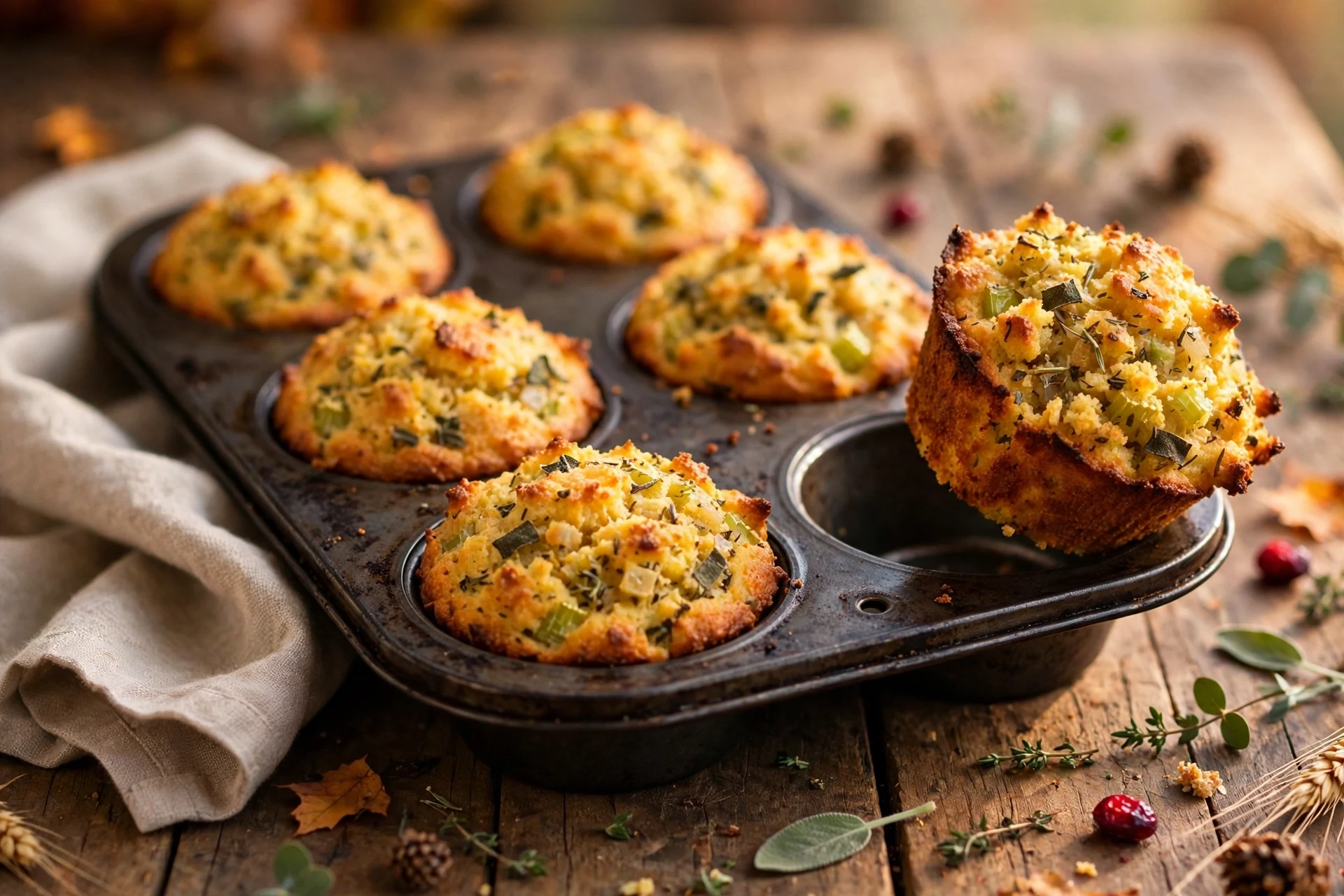
There is a special kind of magic that happens when the buttery corner piece of the stuffing pan — the one everyone quietly fights over — becomes the entire dish. These Easy Cornbread Stuffing Muffins are exactly that magic, in individual 30-minute cups. Golden and crisp around the edges, tender and savory in the middle, with buttery sauteed celery and onion folded through every bite, they taste like the best spoonful of Thanksgiving dressing, just neater, cuter, and way faster.
Let us be honest: a big pan of stuffing is wonderful, but scooping it can be a crumbly wrestling match, and reheating leftovers usually turns the edges soft and sad. Muffin-tin stuffing solves all of it. Each cup bakes up with its own crisp, caramelized crust, the inside stays moist and fluffy, and the portions are built right in — no scooping, no guessing, no sad edge pieces. Kids love them because they look like muffins (and who says no to a muffin?). Hosts love them because twelve perfect cups come out of one pan in about thirty minutes, which is about half the time a full casserole takes.
And the flavor is pure Thanksgiving comfort. Sweet, crumbly cornbread soaks up sage-scented turkey broth and butter, the celery and onion melt into the background, and two beaten eggs turn the whole thing into sturdy, sliceable, dippable little cups that hold their shape on a crowded holiday plate. Pass the gravy boat. You are going to want a second one.
Recipe at a Glance
Prep: 10 minutes | Cook: 20-22 minutes | Total: 30 minutes | Yield: 12 stuffing muffins | Oven: 375°F
Ingredients
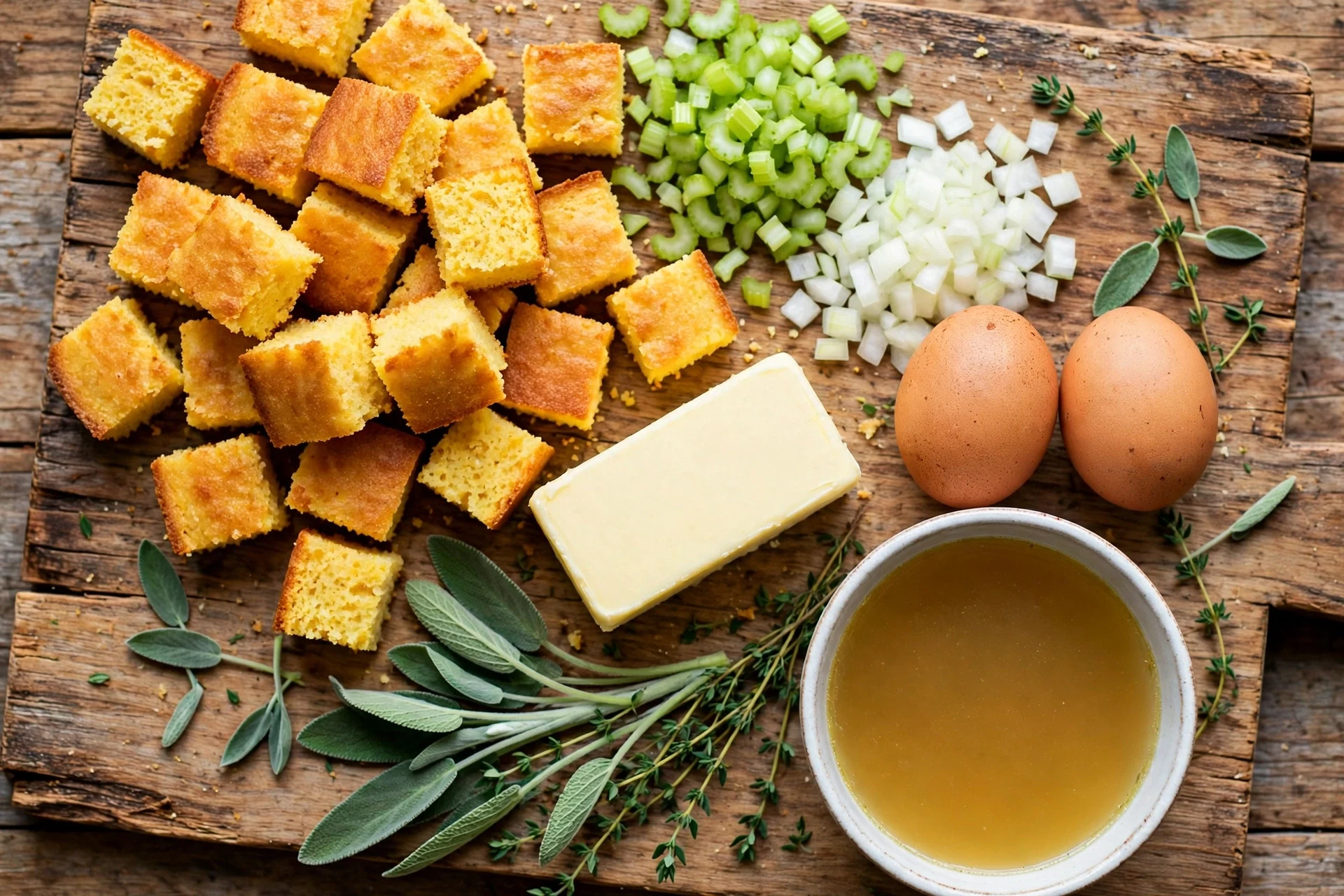
- 6 cups crumbled day-old cornbread (about one 8×8-inch pan of baked cornbread, or store-bought)
- 6 tablespoons unsalted butter, plus extra for greasing the tin
- 2 ribs celery, finely diced
- 1 medium yellow onion, finely diced
- 1 teaspoon rubbed sage
- 1/2 teaspoon dried thyme
- 1 teaspoon kosher salt
- 1/2 teaspoon freshly ground black pepper
- 2 large eggs, beaten
- 1 1/2 cups turkey or chicken broth
- 1/4 cup chopped fresh parsley, plus extra for garnish (optional)
A quick note on the cornbread: Day-old cornbread is your best friend here because it is drier and thirstier — it soaks up the broth without turning to mush. If your cornbread is fresh from the oven, just crumble it and toast the crumbs at 300°F for 8-10 minutes until they feel dry to the touch. Store-bought cornbread mix works beautifully too; nobody at the table will interrogate you about it. What you want to avoid is very sweet, cake-like cornbread — the savory, Southern-style kind gives the best stuffing flavor.
Directions
- Heat the oven and prep the tin. Position a rack in the center of the oven and preheat to 375°F. Generously grease a standard 12-cup muffin tin with butter or nonstick spray — get into every corner, because these little cups love to grip.
- Toast the cornbread crumbs (if needed). If your cornbread is fresh, spread the 6 cups of crumbled cornbread on a rimmed baking sheet and toast at 300°F for 8-10 minutes, stirring once, until the pieces feel dry and lightly crisp. Day-old or stale cornbread can skip this step. Transfer to a large mixing bowl.
- Saute the vegetables. Melt the 6 tablespoons of butter in a large skillet over medium heat. Add the diced celery and onion and cook, stirring often, for 5-6 minutes until soft, sweet, and translucent — not browned. Stir in the sage, thyme, salt, and pepper and cook for 1 more minute until fragrant.
- Cool the vegetables slightly. Take the skillet off the heat and let the mixture cool for about 5 minutes. This little pause matters — pouring hot buttery vegetables straight into beaten eggs can scramble them, and nobody wants bits of cooked egg in their stuffing.
- Combine everything. Add the cooled celery-onion mixture to the bowl of crumbled cornbread along with the parsley. In a measuring cup, whisk the beaten eggs with the 1 1/2 cups of broth, then pour the egg-broth mixture over the cornbread. Toss gently with a spatula until every crumb is moistened — you want damp, not swimming. Let the mixture rest for 5 minutes so the crumbs finish absorbing.
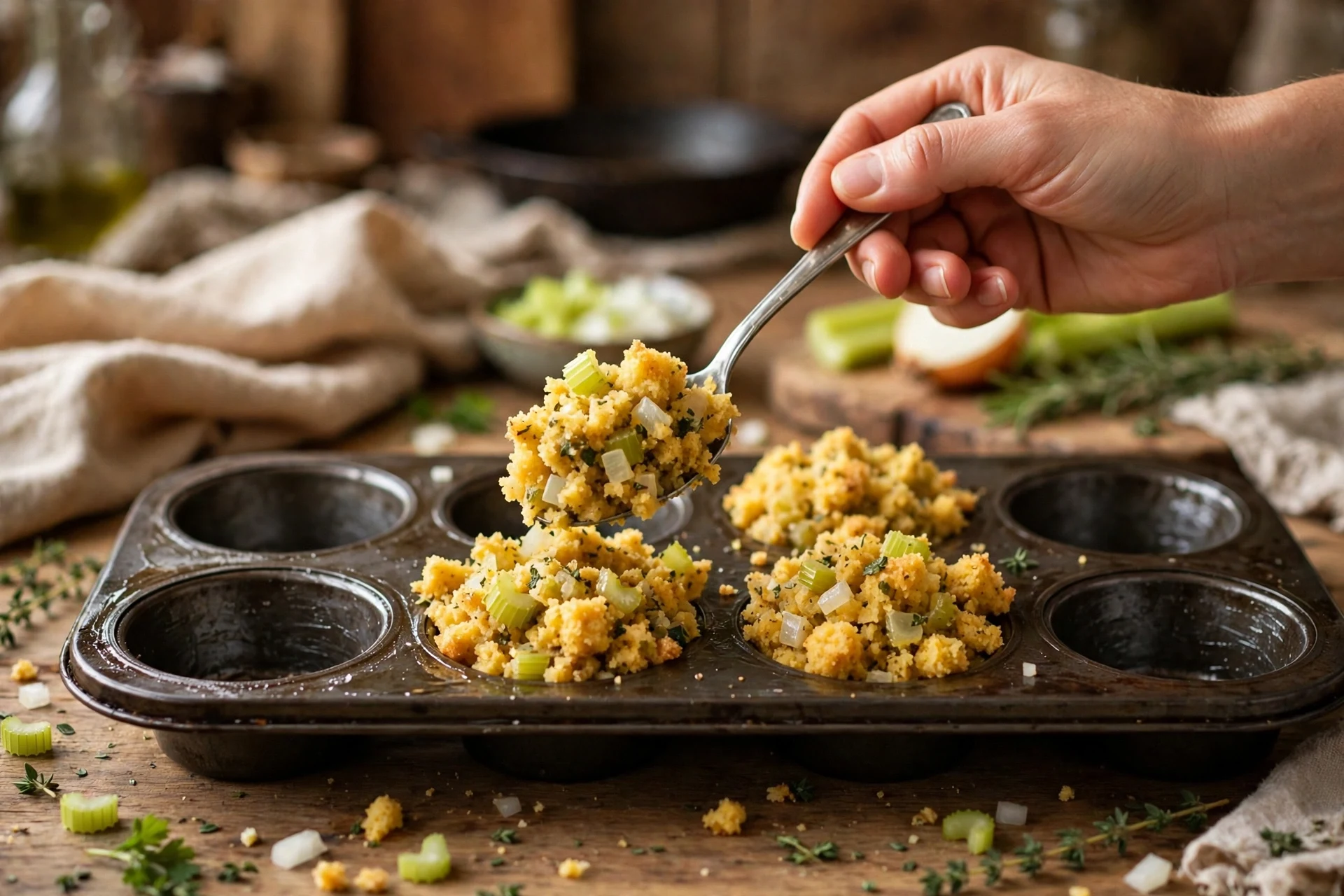
- Fill the cups. Pack the mixture firmly into the prepared muffin cups, mounding it slightly above the rim of each cup. Firm packing is the difference between a sturdy muffin and a crumbly pile — press it in like you mean it.
- Bake 20-22 minutes. Bake until the tops are deeply golden brown, the edges are crisp and pulling slightly away from the tin, and the centers feel firm and spring back when lightly pressed. For full certainty, an instant-read thermometer in the center of a muffin should read at least 160°F, which confirms the eggs are completely set.
- Cool and release. Let the muffins cool in the tin for 5 minutes — this firms them up so they lift out cleanly. Run a thin knife around each cup, twist gently, and lift the muffins onto a wire rack or serving platter. Serve warm, ideally with gravy for drizzling.
Why This Method Works
Why toast the cornbread first? Fresh cornbread is soft and cake-like, and soft crumbs dissolve into broth like wet tissue. Toasting (or simply using day-old cornbread) drives off surface moisture and firms up the crumb, so each piece can drink in the sage-scented broth and stay distinct. That is the whole textural secret of good stuffing: moist crumbs that still have body. Mushy stuffing is almost always fresh-bread stuffing.
Why cool the sauteed vegetables before the eggs? The celery and onion come out of the skillet coated in sizzling butter, easily hot enough to cook beaten egg on contact. Cooling them for about five minutes brings the temperature down below the scrambling zone, so the eggs stay liquid and do their real job in the oven — binding everything together into sturdy cups.
Why pack the cups firmly, but not crush them? A loosely spooned cup bakes up airy and falls apart when you pick it up. A firmly packed cup bakes up with crisp, caramelized edges where the mixture touches the tin — the very crust everyone fights over — while the center stays tender. The key is firm pressure without compacting it into a dense brick; you still want little air pockets so steam can escape and the middle stays fluffy.
Why a muffin tin instead of a casserole dish? Surface area. A muffin tin gives every serving maximum contact with hot metal, which means twelve crispy edges instead of just the corners of a pan, and a 20-22 minute bake instead of 35-45. Faster, crispier, and perfectly portioned — that is the entire case for stuffing muffins.
Pro Tips
- Grease like you are paranoid. These cups have a lot of surface contact, and egg-bound mixtures grip metal. Butter every cup thoroughly, including the rim, or use a generous coat of nonstick spray with flour in it.
- Dice small and evenly. Fine, even dice on the celery and onion means the vegetables melt into the cups instead of poking out and burning on the edges.
- Taste the mixture before baking. Scoop up a tiny spoonful of the moistened mixture (before it goes in the oven, when the eggs are raw, taste the seasoning by pressing a crumb to your tongue). Adjust salt now — you cannot fix seasoning after baking.
- Don’t skip the 5-minute rest. Letting the moistened crumbs sit before filling the tin means the cornbread fully absorbs the broth. Dry spots in the bowl become dry, pale spots in the finished muffins.
- Warm the broth. If your broth is cold from the fridge, warm it gently before mixing — it absorbs faster and the eggs blend in more smoothly.
- Make them mini. A mini muffin tin works with this exact recipe — fill 24 cups and bake 12-15 minutes for adorable two-bite party versions.
Common Mistakes & How to Fix Them
Mistake: The muffins crumble and fall apart. This usually means too little binder or under-baking. Fix: make sure you used both eggs and pressed the mixture firmly into each cup, and bake until the centers truly spring back when pressed — a pale, soft top is an underbaked muffin. If they still feel fragile, give them the full 5-minute tin rest before releasing.
Mistake: The centers are gummy or wet. Too much broth for your particular cornbread. Cornbread crumb density varies, so the 1 1/2 cups is a target, not a law. Fix: add the broth gradually, stopping when the mixture is evenly damp but not soupy. If you overshoot, bake 2-3 minutes longer and check that the centers reach 160°F.
Mistake: The tops browned but the centers are raw. Your oven may run hot. Fix: tent the tin loosely with foil for the last 5-8 minutes of baking so the tops stop darkening while the centers finish. An oven thermometer is a ten-dollar insurance policy worth owning.
Mistake: The muffins stuck to the tin. Under-greasing, plain and simple. Fix: release them while still warm (not hot, not cold) with a thin knife, and next time be lavish with the butter. Silicone muffin pans release more easily, though the edges will be slightly less crisp.
Mistake: They taste bland. Stuffing needs assertive seasoning — cornbread is a flavor sponge, not a flavor source. Fix: salt generously, be bold with the sage, and taste the raw mixture’s seasoning before baking. A pinch more salt fixes more problems than any fancy technique.
Storage & Make-Ahead
Make-ahead: These muffins are a dream for holiday planning. Bake them fully, cool completely, and refrigerate in an airtight container for up to 3 days. Reheat on a baking sheet at 350°F for 10-12 minutes until warmed through and the edges re-crisp — they come back beautifully. You can also assemble the unbaked mixture, cover tightly, and refrigerate for up to 24 hours; pack and bake straight from the fridge, adding 2-3 extra minutes to the bake time.
Leftovers: Cool any leftover muffins within 2 hours of baking — never leave them at room temperature longer than that. Refrigerate in an airtight container for 3-4 days. For freezing, wrap the cooled muffins individually and store in a freezer bag for up to 3 months; thaw overnight in the fridge. Reheat refrigerated or thawed muffins to steaming hot — leftovers should reach 165°F inside for food safety — in a 350°F oven for 10-12 minutes.
Substitutions
- Bread swap: No cornbread on hand? Use 6 cups of cubed day-old French or sourdough bread instead. The muffins will taste more like classic Thanksgiving dressing — still delicious, just less sweet and crumbly.
- Gluten-free: Use your favorite gluten-free cornbread. Everything else in the recipe is naturally gluten-free; just confirm your broth is certified GF.
- Dairy-free: Swap the butter for olive oil or a plant-based butter and use a rich vegetable broth. The edges will not brown quite as deeply, but the flavor holds up.
- Herb swaps: Fresh herbs are lovely here — use 1 tablespoon minced fresh sage and 1 1/2 teaspoons fresh thyme in place of the dried. Poultry seasoning (1 1/2 teaspoons) also works in a pinch.
- Broth swap: Turkey broth is the Thanksgiving classic, but chicken or vegetable broth are both fine. Use low-sodium if you like to control the salt yourself.
- Extra mix-ins: Fold in 1/2 cup of dried cranberries, toasted pecans, crumbled cooked sausage, or diced apple when you combine the wet and dry ingredients. Keep additions to about 1/2 cup total so the muffins still bind.
Serving Ideas
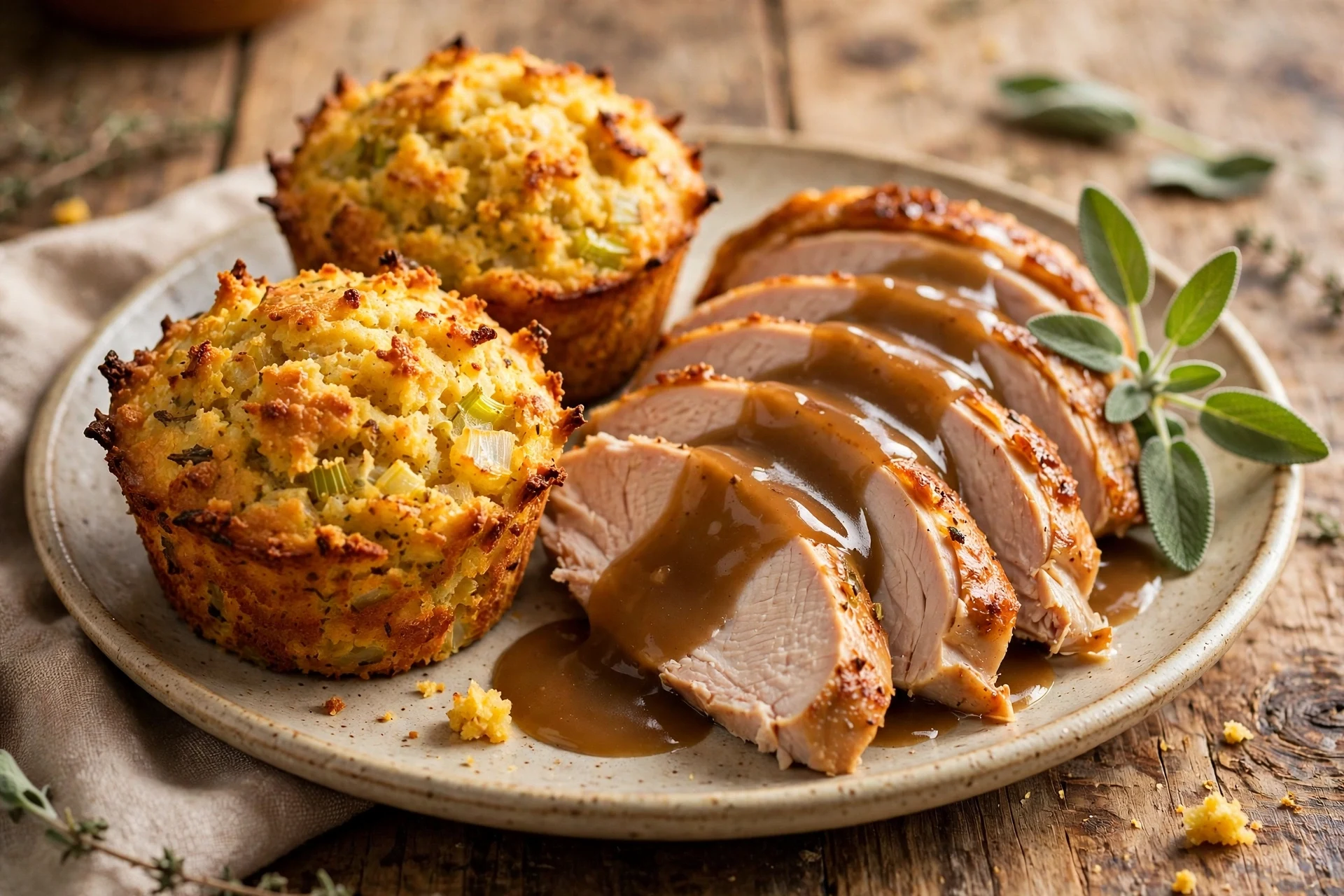
These little cups earn their place at the center of the Thanksgiving table. Serve them warm alongside a Herb Butter Roasted Turkey Breast (Juicy Thanksgiving Main) with a generous pour of Easy Turkey Gravy (15-Minute, No-Drippings Thanksgiving Gravy) over the top — the crisp edges soak up gravy like a dream. Round out the spread with Easy Garlic Butter Dinner Rolls (Soft 60-Minute Thanksgiving Side) for a dinner roll plus stuffing-muffin carb situation nobody will complain about. For a lighter night, pair two muffins with a simple green salad and roasted Brussels sprouts. They also make fantastic game-day snacks with a side of cranberry sauce for dipping, and leftover muffins sliced in half and pan-toasted in butter are a breakfast worth waking up for.
Frequently Asked Questions
Can I make cornbread stuffing muffins ahead of time?
Yes — they are one of the best make-ahead Thanksgiving sides. Bake them fully, cool completely, and refrigerate in an airtight container for up to 3 days. Reheat at 350 degrees F for 10-12 minutes until the edges re-crisp. You can also refrigerate the unbaked assembled mixture for up to 24 hours and bake it straight from the fridge, adding 2-3 extra minutes.
Do I need to use stale cornbread for stuffing muffins?
Day-old or stale cornbread gives the best texture because it is drier and absorbs broth without turning mushy. If your cornbread is fresh, crumble it and toast at 300 degrees F for 8-10 minutes until dry to the touch — this takes only a few extra minutes and makes a real difference in the final texture.
Why did my stuffing muffins fall apart?
Crumbly muffins usually mean they were under-baked, loosely packed, or short on binder. Press the mixture firmly into each cup, use both eggs as written, and bake until the tops are deeply golden and the centers spring back when pressed (at least 160 degrees F inside). Let them rest 5 minutes in the tin before releasing.
Can I freeze cornbread stuffing muffins?
Yes. Cool the baked muffins completely, wrap them individually, and freeze in a zip-top bag for up to 3 months. Thaw overnight in the refrigerator, then reheat at 350 degrees F for 10-12 minutes until steaming hot throughout (165 degrees F inside).
Rate this recipe
Be the first to rate it!