
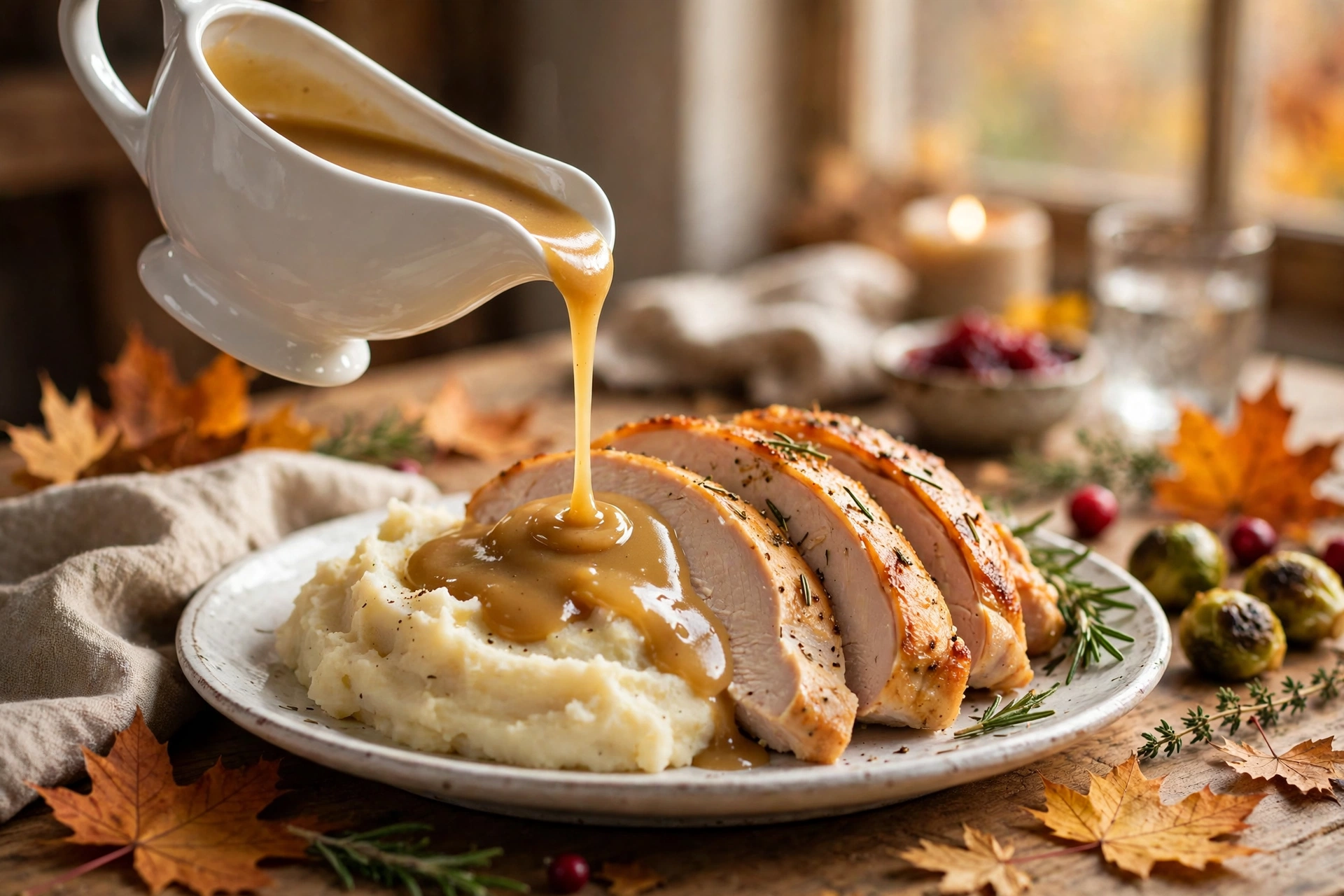
Every Thanksgiving table has a moment of truth: the turkey is carved, the mashed potatoes are piled high, and everyone is waiting for the gravy boat. This easy turkey gravy is the one that makes the whole plate sing. It is silky, glossy, and deeply savory, and it comes together in 15 minutes flat — 5 minutes of prep and 10 minutes of cooking — with no pan drippings required. A simple butter roux, good turkey broth, and a handful of herbs deliver a gravy so smooth and golden that nobody will guess it skipped the traditional drippings step. Pour it over sliced herb butter roasted turkey breast and watch the table go quiet.
Recipe at a Glance
- Prep time: 5 minutes
- Cook time: 10 minutes
- Total time: 15 minutes
- Yield: About 2 1/2 cups (serves 8, about 1/3 cup each)
- Difficulty: Easy — one saucepan, one whisk, zero stress

Why This Method Works
Gravy is one of the oldest sauces in the world — the long history of gravy stretches back centuries — and the technique here is classic for a reason.
A fat-flour roux beats a cornstarch slurry
You can thicken gravy two ways: stir flour into hot fat (a roux) or stir cornstarch into cold liquid and add it at the end (a slurry). The roux wins on flavor every time. When flour cooks in butter for a couple of minutes, it toasts — creating nutty, savory flavor compounds a cornstarch slurry cannot produce. Beyond flavor, the fat coats each starch granule, so when the broth goes in, the granules disperse smoothly instead of clumping. That is the real secret to lump-free gravy: the fat separates the starch before the liquid ever arrives. Cornstarch gives a slick, almost gelatinous gloss and breaks down when reheated — exactly what you do not want in a make-ahead Thanksgiving side.
Warm liquid tempering prevents lumps
Lumps happen when starch meets liquid too fast: the outside of each flour particle gelatinizes instantly, sealing dry flour inside a waterproof shell. Pouring warm — not fridge-cold, not boiling — broth into the hot roux while whisking constantly gives every starch granule a gradual introduction to the liquid, so they swell evenly and you get that mirror-smooth body. Cold broth shocking a hot roux is the number one cause of lumpy gravy in home kitchens.
A full simmer finishes the job
Flour needs a full simmer to finish its work. At a rolling bubble — a true 212°F simmer — the starch granules swell to maximum, the raw flour taste cooks away, and the gravy thickens to its final consistency. A gravy that never quite reaches a simmer will taste faintly of paste and stay thin. Five minutes of honest bubbling also keeps everything food-safe: no bacteria survive a full rolling simmer. If you swap in real pan drippings from your turkey, this step matters even more — always bring drippings-based gravy to a full simmer before serving.
Ingredients
- 4 tablespoons unsalted butter
- 1/4 cup all-purpose flour
- 2 1/2 cups turkey broth or chicken broth, warmed
- 1/2 teaspoon freshly cracked black pepper
- 1/2 teaspoon fresh thyme leaves, finely chopped (or 1/4 teaspoon dried thyme)
- 1 teaspoon fresh sage, finely chopped (or 1/4 teaspoon dried rubbed sage)
- 1/4 teaspoon fine sea salt, plus more to taste
- Optional drippings upgrade: replace 2 tablespoons of the butter with 2 tablespoons of turkey pan-drippings fat

Directions
- Warm the broth. Heat the turkey broth until steaming — not boiling, just hot to the touch. Warm broth meets the hot roux without shocking it: your insurance against lumps.
- Melt the butter. Set a medium saucepan over medium heat and melt the butter until foamy. If you saved drippings fat from your turkey, add it now for extra roasted flavor.
- Build the roux. Sprinkle in the flour and whisk immediately. Keep whisking for 2 full minutes until the mixture turns light golden and smells toasty, like pie crust. This erases any raw flour taste.
- Add the broth. Whisk in about 1/2 cup of warm broth — the mixture will seize into a thick paste, and that is exactly right. Then pour in the rest in a slow, steady stream, whisking constantly and scraping the pan corners.
- Simmer to silky. Bring to a full, rolling simmer and cook 5 minutes, whisking often, until it coats the back of a spoon and leaves a clean line when you drag your finger through it. Stir in the thyme, sage, and black pepper, then salt to taste.
- Serve it hot. Pour into a warm gravy boat and serve right away over turkey, easy make-ahead mashed potatoes, and stuffing. Nothing on a Thanksgiving plate says no to this gravy.

Pro Tips
- Use a whisk, not a spoon. A balloon whisk reaches the corners of the pan and breaks up flour pockets far better than a wooden spoon — the single best tool for gravy.
- Start with low-sodium broth. Broth concentrates as the gravy simmers, and regular broth can push the salt over the edge. You can always add salt at the end.
- Keep it warm without breaking it. Hold the gravy on the lowest heat with the lid ajar while the turkey rests, or pour it into a warmed thermos. Whisk any skin back in before serving.
- Sop it up. Warm garlic butter dinner rolls exist for exactly one Thanksgiving purpose: mopping the last of the gravy off the plate.
Common Mistakes & Fixes
Lumpy gravy: Whisk vigorously for 30 seconds — many small lumps dissolve with effort. For stubborn lumps, pour through a fine-mesh sieve, pressing with the back of a ladle, or blitz 10 seconds with an immersion blender. Next time: warm broth, constant whisking.
Too thin: Simmer a few minutes longer — gravy thickens as it bubbles. In a hurry? Mash 1 tablespoon of soft butter with 1 tablespoon of flour into a smooth paste (a French beurre manié), whisk it in, and simmer 2 minutes.
Too thick: Whisk in warm broth a splash at a time until it flows the way you like. Gravy thickens as it cools, so aim slightly looser than your target in the pan.
Too salty: Dilute with a splash of unsalted broth or water; a tiny pinch of sugar rounds out harsh saltiness. Prevention is better: unsalted butter and low-sodium broth from the start.
Raw flour taste: The roux needed more time. Two full minutes of toasting plus the 5-minute simmer erase it completely; simmer 2 to 3 minutes more if you are already there.
Make-Ahead & Storage
Gravy is a wonderful make-ahead side — one less thing bubbling while the turkey rests. Make it up to 3 days ahead: cool quickly, refrigerate in an airtight container, and reheat gently over medium-low heat, whisking often and loosening with a splash of warm broth. Food safety first: never leave gravy out on the counter for more than 2 hours. Refrigerated gravy keeps for 4 days; frozen gravy keeps for up to 3 months (thaw overnight in the fridge, then reheat with a splash of broth, whisking well). A proper roux-thickened gravy reheats beautifully and never breaks the way cornstarch gravies do.

Substitutions
- No turkey broth? Good chicken broth works perfectly. In a pinch, vegetable broth works too, though the flavor will be lighter.
- Gluten-free: Swap the all-purpose flour for a 1:1 gluten-free flour blend. It toasts and thickens the same way — keep the same 2 minutes.
- Fresh herbs to dried: Use one-third the amount. Dried herbs go in with the simmer so they have time to bloom.
- Extra richness: Stir in 2 tablespoons of heavy cream or a knob of cold butter at the very end, off the heat, for a restaurant-style gloss.
- Curious about nutrition? The USDA FoodData Central database hosts the official nutrient data for prepared turkey gravy.
FAQ
Can you make turkey gravy without drippings?
Absolutely — this entire recipe is built for it. A butter-and-flour roux plus a good, rich turkey or chicken broth creates deep savory flavor without a single drop of pan drippings. If you do have drippings, you can swap 2 tablespoons of the butter for drippings fat for extra roasted flavor, but the gravy is rich and silky either way.
How do you fix lumpy gravy?
Whisk vigorously for 30 seconds first — many small lumps dissolve with effort alone. For stubborn lumps, strain the gravy through a fine-mesh sieve into a clean pot, pressing with the back of a ladle, or blitz it for 10 seconds with an immersion blender. To prevent lumps next time, use warm (not cold) broth and whisk constantly as you pour.
How long can turkey gravy sit out?
Follow the 2-hour rule: never leave gravy at room temperature for more than 2 hours. Refrigerate leftovers promptly in an airtight container, where they keep for 4 days, or freeze for up to 3 months. Reheat gently to a simmer before serving.
Can I make turkey gravy ahead of time?
Yes — gravy is an ideal make-ahead side. Prepare it up to 3 days before Thanksgiving, cool it quickly, and refrigerate in an airtight container. Reheat gently over medium-low heat, whisking often, and loosen with a splash of warm broth if it thickened in the fridge. It reheats beautifully because a roux-thickened gravy does not break the way cornstarch gravies do.
So there it is — the gravy that ties the whole Thanksgiving plate together, no drippings required and no drama involved. Make it ahead, pour it generously, and keep the boat close. Happy Thanksgiving, and happy pouring.
Rate this recipe
Be the first to rate it!
1 thought on “Easy Turkey Gravy (15-Minute, No-Drippings Thanksgiving Gravy)”