
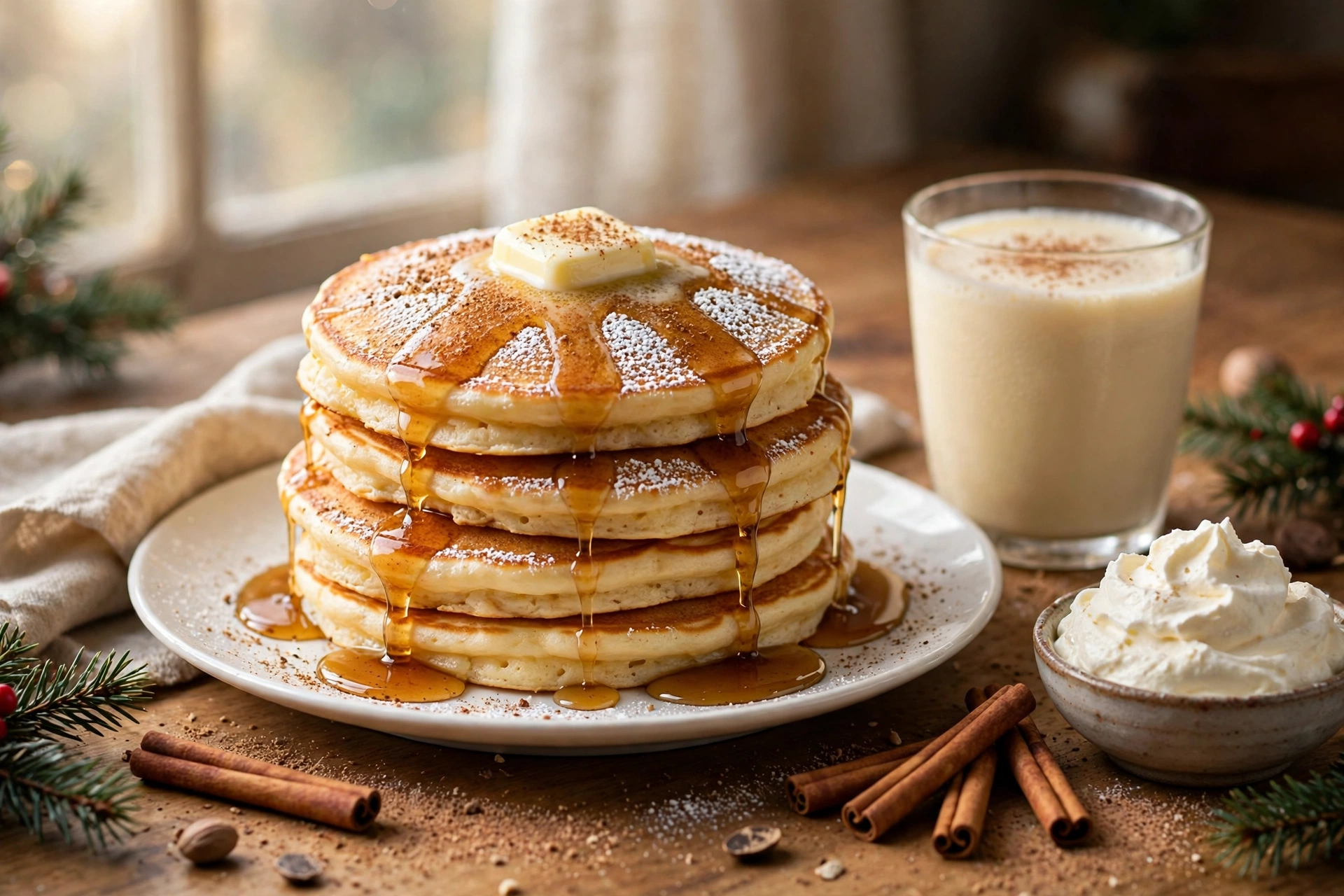
There is a smell that means Christmas morning in our house, and it is not the tree or the wrapping paper. It is eggnog pancakes on the griddle: warm nutmeg and cinnamon rising off a stack of golden, fluffy pancakes, butter melting down the sides, maple syrup pooling on the plate. These Easy Eggnog Pancakes take that smell and put it on your table in 20 minutes flat, and they taste like the holidays decided to show up for breakfast. The eggnog does the heavy lifting here. It replaces the milk in an ordinary pancake batter and brings its own creamy richness, its own gentle sweetness and its own whisper of nutmeg, so the pancakes come out tender, custardy in the middle and golden at the edges, with a flavour that tastes far more special than the effort involved.
Eggnog is a classic holiday drink made from milk, cream, sugar, eggs and warm spices like nutmeg and cinnamon, and it has been poured at Christmas gatherings for centuries. Folding it into pancake batter is one of the smartest things you can do with a carton of it, because everything that makes eggnog lovely to drink makes pancakes lovely to eat. The cream and egg in the eggnog enrich the batter the way buttermilk does, the nutmeg and cinnamon are already in there, and the gentle sweetness means you barely need any extra sugar. If you have ever opened the fridge on a December morning, seen a carton of eggnog, and wondered what to do with it beyond a glass, this is the answer.
This recipe keeps everything simple and honest, the way a Christmas morning recipe should be. One bowl for the dry ingredients, one bowl for the wet, a three-minute rest while the griddle heats, and ten minutes of cooking. There is no special equipment, no fussy technique, and no long list of steps standing between you and breakfast. If you can whisk a bowl and flip a pancake, you can make eggnog pancakes, and once you have made them, the carton of eggnog in your fridge will never survive December again.
What makes these Easy Eggnog Pancakes such a reliable favourite is how forgiving they are. The batter welcomes a slightly heavy hand, the pancakes forgive a griddle that runs a touch hot, and the whole batch lands on the table warm and golden in minutes. Serve them piled high with whipped cream, a snowfall of powdered sugar and an extra grating of nutmeg, and watch how fast they disappear. Four servings, 20 minutes, one griddle, and a breakfast that tastes like Christmas morning itself.
Eggnog safety note: always use store-bought pasteurised eggnog for this recipe. Store-bought eggnog is made with pasteurised eggs and milk, so it is safe to use straight from the carton. If you make eggnog at home, cook the egg base to 160 degrees Fahrenheit and chill it before using it in the batter, and never use raw eggs in an uncooked drink. The pancakes themselves are fully cooked on the griddle, so the eggs in the batter are cooked through by the time they reach the table.
Recipe at a Glance
Prep time: 10 minutes | Cook time: 10 minutes | Total time: 20 minutes | Servings: 4 servings | Yield: 12 pancakes (3 per serving)
Why This Recipe Works
Great eggnog pancakes are not an accident. They are the result of a few small technique choices that each do a real job, and once you understand the why behind them, the recipe becomes yours forever. The first choice is using eggnog instead of milk, and it earns its place for a simple reason: eggnog is already a rich, spiced, slightly sweet dairy drink, so it enriches the batter in three ways at once. The cream in it makes the pancakes tender, the sugar in it helps them brown beautifully on the griddle, and the nutmeg and cinnamon already dissolved in it flavour the batter from the inside out. A pancake made with plain milk needs help to taste special; a pancake made with eggnog arrives special.
The second choice is the combination of baking powder and baking soda, and it matters because eggnog is a rich, heavy liquid. Baking powder does the main lifting, creating the bubbles that make the pancakes tall and fluffy, while the half teaspoon of baking soda reacts with the slight acidity of the dairy and helps the pancakes brown to a deep, even gold. Together they give you a pancake that rises high in the pan and stays soft inside, instead of a flat, dense disc. Make sure both are fresh: baking powder older than six months loses its lift, and flat pancakes are almost always a stale leavener problem, not a recipe problem.
The third choice is resting the batter for three minutes, and it is the quiet hero of this recipe. When flour meets liquid, the flour needs a moment to absorb the moisture and the gluten needs a moment to relax, and that short rest is what turns a thin, runny batter into a thick, scoopable one that holds its shape on the griddle. Rest too long and the baking powder spends its lift before the batter hits the pan, so three minutes is the sweet spot: long enough to thicken, short enough to keep the bubbles. Use those three minutes to heat the griddle, and no time is wasted at all.
The fourth choice is cooking on medium-low heat, and it earns its place because eggnog batter browns faster than plain batter. The sugar in the eggnog caramelises quickly, which is wonderful for colour but dangerous for burning, so a moderate griddle gives the inside time to cook through while the outside turns a gentle gold. The doneness cue is unambiguous: bubbles appear across the surface, the edges look set and dry, and the pancake feels firm when you slide the spatula underneath. Flip once, cook the second side until golden, and the centre will be fully set and spring back when pressed, which is how you know the eggs are cooked through.
The fifth choice is the melted butter in the batter, and it does more than add flavour. Butter coats the flour and shortens the gluten strands, which is what keeps the crumb tender instead of tough, and it carries the vanilla and spice flavours through the batter so every bite tastes the same. Let the butter cool for a minute after melting before you whisk it in, because hot butter poured into cold eggnog can curdle the dairy and leave little flecks in the batter. Warm, not hot, is the rule, and it is a small detail that makes a visible difference.
Eggnog and eggs are a naturally strong pair nutritionally as well as in flavour, and the spices do real work too. Cinnamon and nutmeg add warmth and aroma without any sugar at all, and the eggs supply protein that keeps a breakfast satisfying until lunch. The USDA FoodData Central database lists the nutrient profiles for eggs, milk and nutmeg, and it is a useful reminder that a holiday breakfast built from real ingredients can be both joyful and nourishing in a sensible portion for four people. Nothing here makes a medical claim; it is simply good food, made from good ingredients, on a Christmas morning.
Finally, this recipe works because it respects the 20-minute promise. The dry ingredients are whisked while the butter melts, the wet ingredients come together in one bowl, and the batter rests while the griddle heats. Every step overlaps with the next, which is how 10 minutes of prep and 10 minutes of cooking add up to a breakfast that tastes like it took all morning.
Ingredients
For the dry ingredients
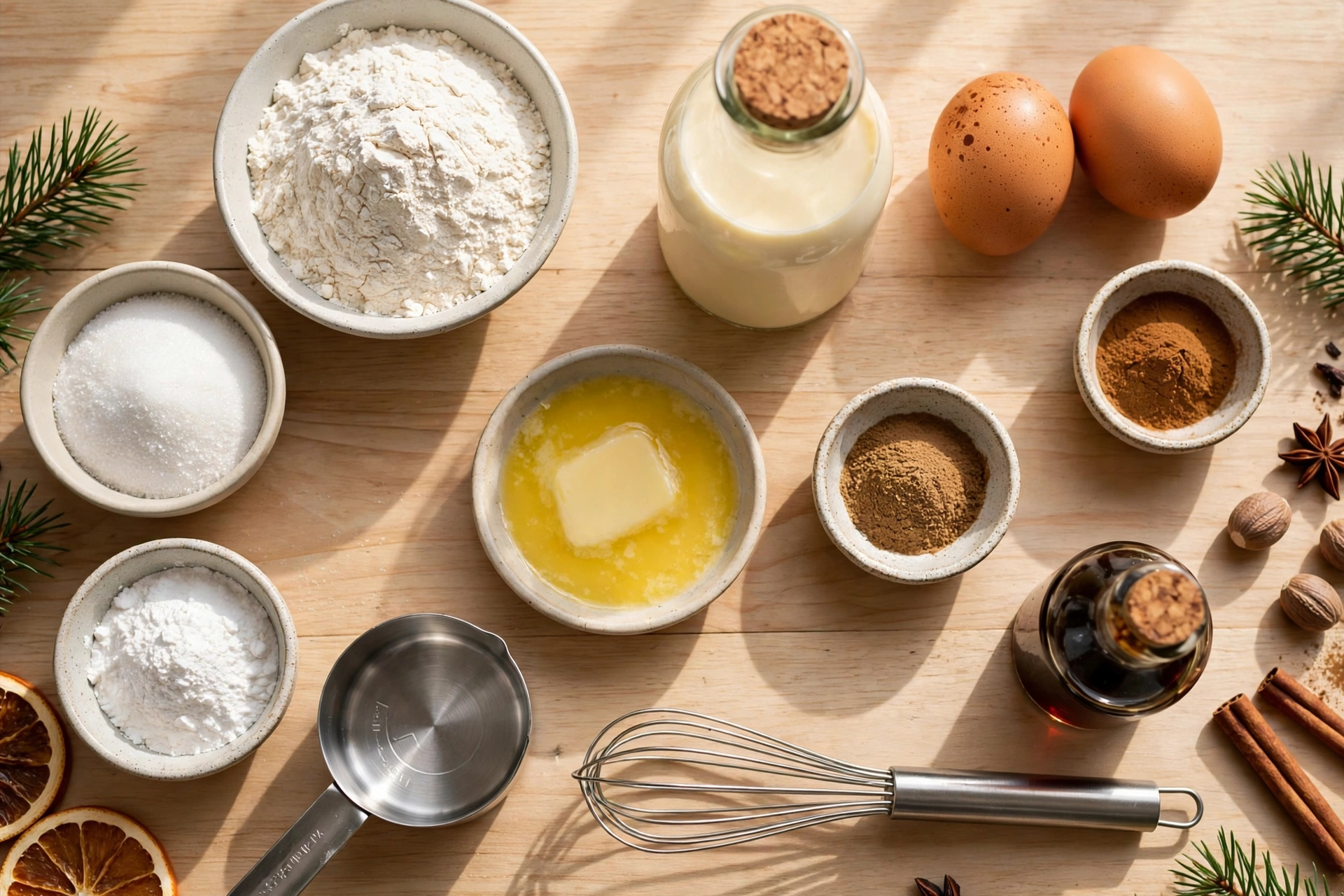
- 2 cups all-purpose flour, spooned and levelled
- 2 tablespoons granulated sugar
- 2 teaspoons baking powder
- 1/2 teaspoon baking soda
- 1/2 teaspoon fine salt
- 1 teaspoon ground cinnamon
- 1/2 teaspoon ground nutmeg, freshly grated if you have it
For the wet ingredients
- 1 1/2 cups eggnog, store-bought and pasteurised
- 2 large eggs
- 3 tablespoons unsalted butter, melted and slightly cooled
- 1 teaspoon vanilla extract
For the griddle and serving
- 1 tablespoon unsalted butter, for the griddle
- Warm maple syrup, for serving
- Whipped cream, for serving
- Powdered sugar and extra grated nutmeg, for dusting
Directions
- Whisk the dry ingredients (3 minutes). In a large bowl, add the flour, sugar, baking powder, baking soda, salt, cinnamon and nutmeg. Whisk them together for a full minute until the spices are evenly distributed and there are no clumps of baking powder hiding in the flour. A clump of baking powder in the batter becomes a bitter spot in a pancake, so this minute of whisking is worth it. Set the bowl aside.
- Whisk the wet ingredients (4 minutes). In a medium bowl or large measuring jug, whisk the eggnog and eggs together until they are completely combined and smooth. Add the melted butter, which should be warm but not hot, and the vanilla extract, and whisk again until the mixture is uniform. If the eggnog is very cold from the fridge, let the bowl sit on the counter for a few minutes first, because cold eggnog thickens the melted butter into little flecks. The wet mixture should look creamy and pale gold, with the nutmeg speckling it lightly.
- Combine and rest the batter (3 minutes). Pour the wet ingredients into the dry ingredients and stir gently with a wooden spoon or spatula until they are just combined. Stop the moment the flour disappears, even if a few small lumps remain, because lumps are fine and overmixing is not. Let the batter rest for 3 minutes while you heat the griddle. It will thicken slightly as the flour absorbs the eggnog, and that thickness is what makes tall, fluffy pancakes instead of thin, flat ones.
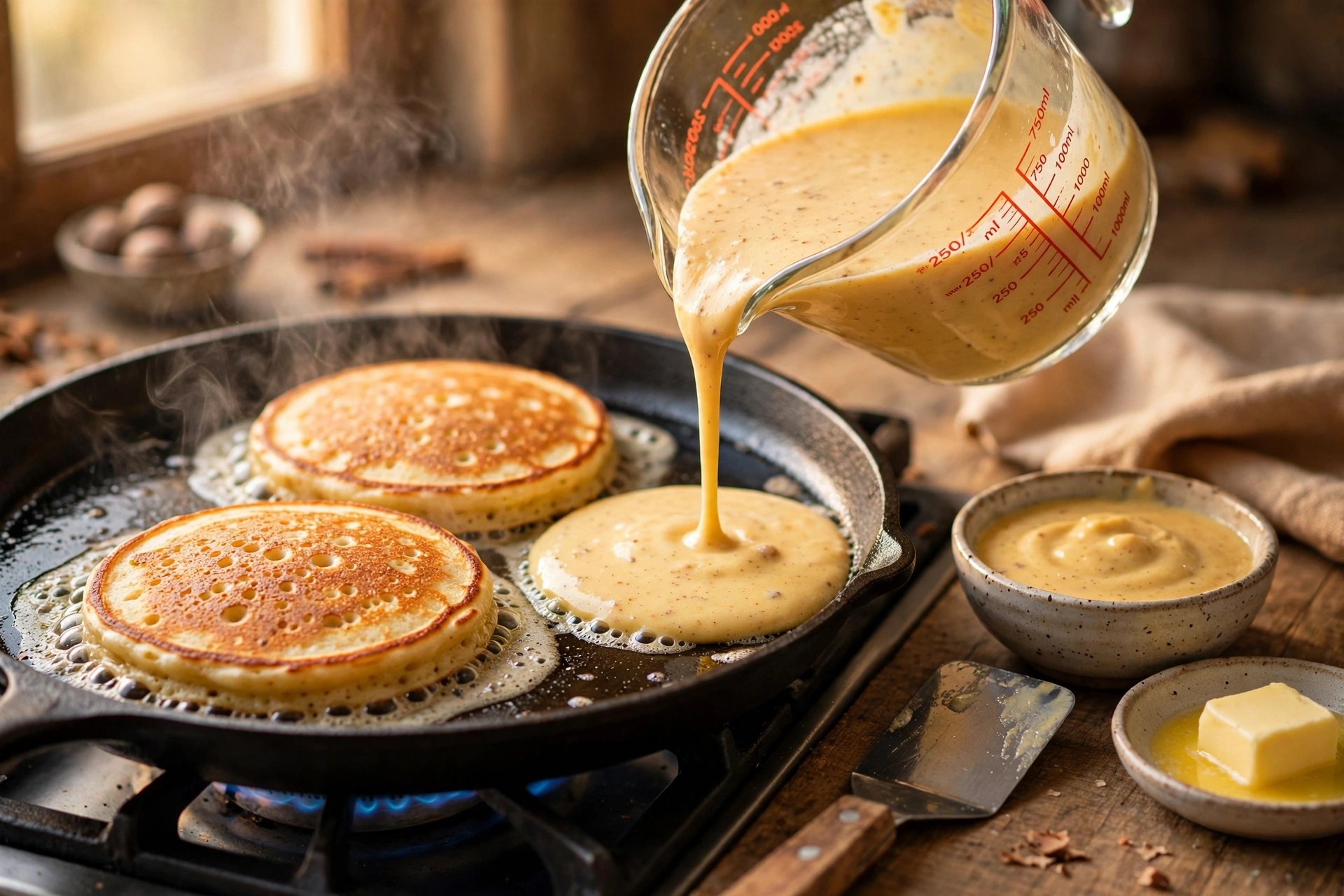
- Heat the griddle and cook the first batch (4 minutes). Set a large griddle or skillet over medium-low heat and melt the tablespoon of butter, swirling it to coat the surface. Test the heat with a drop of batter: it should sizzle gently, not spit and smoke. Scoop 1/4 cup of batter per pancake, leaving space between them, and cook for about 2 minutes, until bubbles appear across the surface and the edges look set and dry. Flip once with a thin spatula and cook the second side for about 2 minutes more, until it is deep golden and the centre springs back when pressed lightly. Move the finished pancakes to a warm plate and cover loosely with foil.
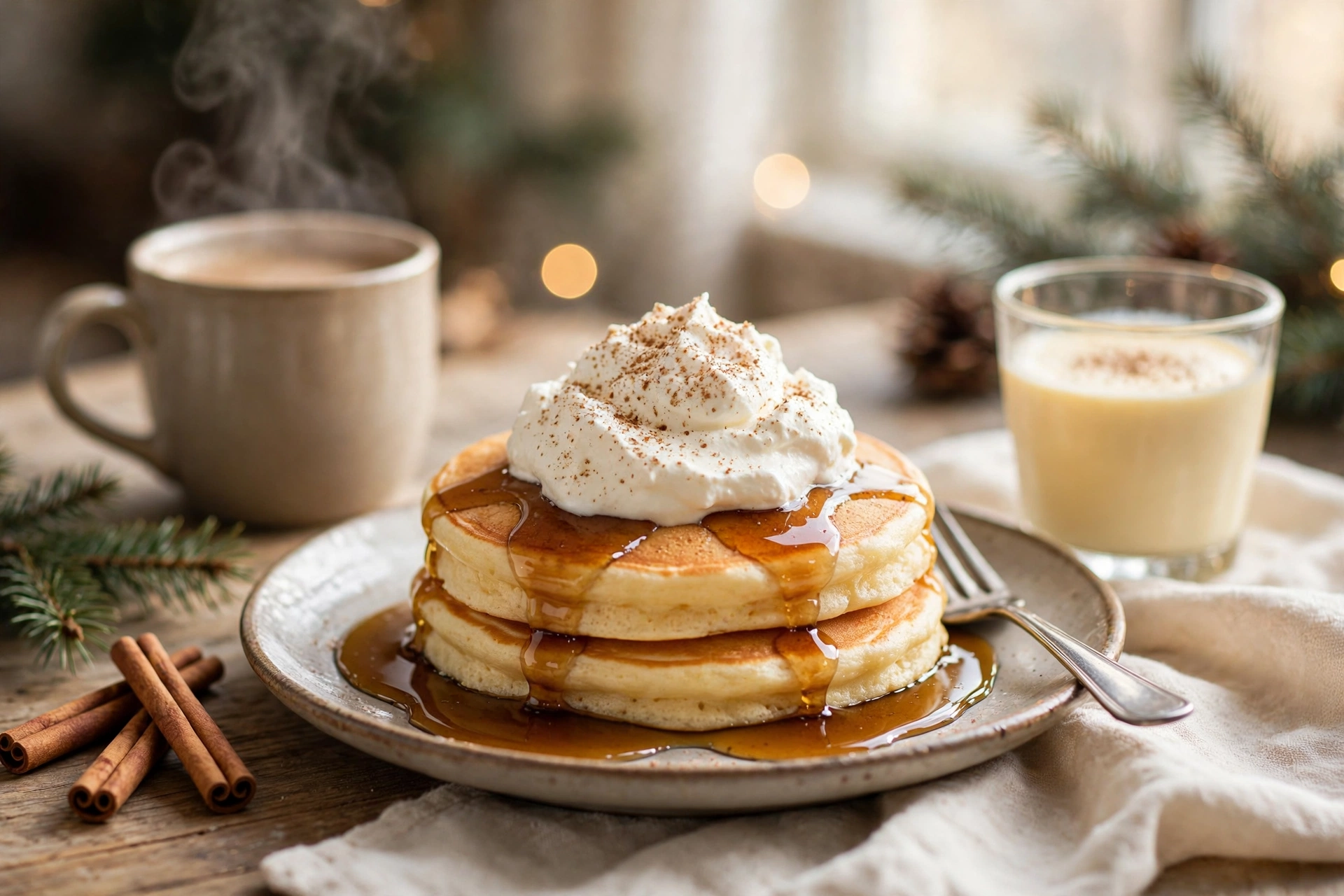
- Cook the remaining batches and serve (6 minutes). Wipe the griddle lightly and add a little more butter only if the surface looks dry, then repeat with the remaining batter in two more batches of four, about 2 to 3 minutes per batch. Keep the finished pancakes warm under the foil as you go. Serve immediately in stacks of three, with warm maple syrup, a dollop of whipped cream, a dusting of powdered sugar and an extra grating of nutmeg over the top.
Pro Tips
The difference between good eggnog pancakes and unforgettable eggnog pancakes lives in the small details, and these are the ones that matter most. First, do not overmix the batter. This is the single most common reason home pancakes turn tough instead of tender. Stir only until the flour disappears, then put the spoon down. A few lumps are not a problem; they cook out on the griddle, and they are the sign of a batter that was treated gently. If your batter looks perfectly smooth, you have probably stirred it too much.
Second, keep the heat at medium-low and be patient. Eggnog batter browns faster than plain batter because of the sugar in the eggnog, and a hot griddle will burn the outside before the inside is cooked. The first pancake is always the test pancake: if it browns in under a minute, turn the heat down and wait a minute before the next batch. A griddle that is too cool is far easier to fix than one that is too hot, and golden, evenly browned pancakes are worth the extra minute.
Third, measure the flour properly. Scooping flour straight from the bag with the measuring cup packs it down and can add a quarter cup or more, which makes dense, dry pancakes. Spoon the flour into the cup and level it off with a knife, and your pancakes will be light every time. This one habit fixes more pancake problems than any other, and it takes five seconds.
Fourth, keep the finished pancakes warm the right way. A low oven at 200 degrees Fahrenheit with the pancakes in a single layer on a baking sheet keeps them warm without steaming them soft, while stacking them under foil traps steam and makes the bottom ones soggy. If you do not want the oven on, a plate covered loosely with foil works for the few minutes the next batch takes. Serve them the moment the last batch lands, because pancakes wait for no one.
Fifth, grate the nutmeg fresh if you possibly can. Freshly grated nutmeg is warmer, sweeter and far more fragrant than the ground nutmeg that has sat in a jar for a year, and in a recipe where nutmeg is the star, the difference is real. A whole nutmeg and a small grater cost very little and last for months, and one nutmeg grates into dozens of breakfasts. If you only have ground nutmeg, it still works beautifully, so do not let it stop you.
Sixth, if your family loves holiday breakfasts, this recipe is a gateway. The same quick-batter thinking works across the whole Christmas breakfast table, and the warm spices here pair beautifully with other seasonal mornings. For another spiced pancake morning, try our gingerbread pancakes, which use the same one-bowl method with molasses and ginger. And if your family loves warm, cinnamon-spiced breakfasts in general, our easy cinnamon apple oatmeal brings the same cozy flavour to a weekday bowl in 20 minutes.
Common Mistakes
The most common eggnog pancake mistake is overmixing the batter. Vigorous stirring develops the gluten in the flour, and developed gluten makes pancakes tough, chewy and flat instead of tender and tall. The fix is simple: stir until the flour just disappears, then stop, lumps and all. If your pancakes come out tough, overmixing is almost always the reason, and a gentler hand next time fixes it completely.
The second mistake is cooking on too high a heat. Eggnog batter browns fast, and a screaming-hot griddle burns the outside while the centre stays raw and wet. The fix is medium-low heat and the bubble test: wait for bubbles across the surface and set, dry edges before flipping, and give the second side its full two minutes. If the outside is dark and the inside is wet, the griddle was too hot, and the next batch on a lower heat will be perfect.
The third mistake is using cold eggnog straight from the fridge with hot melted butter. The cold dairy seizes the butter into little solid flecks, and the batter ends up uneven. The fix is letting the eggnog sit on the counter for a few minutes and letting the butter cool until it is warm, not hot, before whisking them together. If flecks do appear, whisk the wet mixture an extra thirty seconds and they will mostly disappear.
The fourth mistake is flipping too early. A pancake flipped before the surface bubbles and the edges set will tear, fold and deflate, and it will never recover its height. The fix is patience: wait for the bubbles, wait for the edges to look dry, and slide the spatula cleanly underneath before lifting. One confident flip is better than three nervous ones, and the first side should be a deep, even gold when you turn it.
The fifth mistake is skipping the rest. Batter cooked the second it is mixed spreads thin on the griddle and makes flat, wide pancakes, because the flour has not had time to absorb the liquid. The fix is the three-minute rest while the griddle heats, which thickens the batter into a scoopable consistency that holds its shape. Three minutes feels like nothing, and it changes the pancake completely.
Substitutions
This recipe is wonderfully flexible, and most swaps keep the spirit of the dish intact. If you do not have eggnog, the closest swap is 1 1/4 cups of whole milk plus 1/4 cup of heavy cream, with an extra 1/2 teaspoon of nutmeg and a pinch of cinnamon stirred in, which mimics the richness and spice of eggnog. Buttermilk also works and makes a tangier pancake, though it is thinner than eggnog, so use 1 1/4 cups and expect a slightly thinner batter. Do not use skim milk on its own, because the batter will be too thin and the pancakes will lack the custardy richness that makes this recipe special.
The spices can flex to your pantry as well. Swap the cinnamon for pumpkin pie spice, using the same teaspoon, for a slightly different holiday warmth, or add a pinch of ground ginger for a gentle heat that suits the nutmeg. A little orange zest, about a teaspoon, folded into the wet ingredients adds a bright note that cuts through the richness beautifully, and it is lovely on a Christmas morning table. If nutmeg is not your spice, allspice is the closest single swap, though it is stronger, so use a quarter teaspoon instead of a half.
For the toppings, the maple syrup can shift to suit your table. Warm honey, a dusting of powdered sugar on its own, or a spoonful of cranberry sauce all work beautifully with the spiced pancakes, and a handful of fresh berries adds colour and a tart contrast to the rich batter. Whipped cream is the classic partner, but a smear of cream cheese frosting thinned with a little milk turns the stack into a dessert-worthy breakfast for a special morning. And if your family loves single-mug holiday breakfasts too, our easy pumpkin spice mug cake brings the same warm spice to one mug in 7 minutes.
To make the pancakes dairy-free, use a plant-based eggnog, which is now sold in most supermarkets through the holidays, and swap the butter for the same amount of melted coconut oil or a neutral vegetable oil. The texture stays tender and the spice stays warm, though the flavour will be a little lighter than the dairy version. For a gluten-free table, a cup-for-cup gluten-free flour blend works in place of the all-purpose flour, and the batter benefits from an extra minute of rest so the blend fully hydrates. Whatever swap you make, keep the egg in the recipe, because it is the egg that gives the pancake its lift and its golden colour.
Storage & Make-Ahead
Eggnog pancakes are at their best fresh from the griddle, but they are also one of the easiest breakfasts to make ahead. Whisk the dry ingredients the night before and keep them in a covered bowl on the counter, and whisk the wet ingredients and keep them in a sealed jug in the fridge, then combine them in the morning and rest the batter for three minutes as usual. The batter itself should not be mixed the night before, because the baking powder spends its lift overnight and the morning pancakes come out flat. Five minutes of evening prep makes a Christmas morning feel effortless.
If you do have leftovers, let the pancakes cool completely, then stack them with a small square of parchment paper between each one and keep them in an airtight container in the fridge for up to 2 days. Reheat them in a toaster or a dry skillet over medium-low heat until they are warm all the way through, which keeps the edges crisp in a way the microwave never does. The 2-hour room-temperature rule applies here as it does to all cooked food: never leave finished pancakes sitting out on the counter for more than 2 hours.
For the freezer, the same parchment-separated stack goes into a freezer bag with the air pressed out, and it keeps for up to 2 months. Reheat frozen pancakes straight from the freezer in the toaster on a medium setting, or warm them in a 350 degree Fahrenheit oven for about 8 minutes, until they are hot in the centre. A fresh dusting of powdered sugar and a little warm maple syrup makes a reheated pancake taste nearly as good as fresh, and a double batch on a quiet morning becomes breakfast for a whole week of busy ones.
Frequently Asked Questions
Can I make eggnog pancakes ahead of time?
Yes, whisk the dry ingredients the night before and keep them in a covered bowl, and whisk the wet ingredients and keep them in a sealed jug in the fridge. Combine them in the morning, rest the batter for 3 minutes, and cook as usual. Do not mix the full batter the night before, because the baking powder loses its lift overnight and the pancakes come out flat. Cooked pancakes keep in the fridge for up to 2 days or in the freezer for up to 2 months.
Can I use homemade eggnog instead of store-bought?
Yes, as long as the eggnog is made safely. Store-bought pasteurised eggnog is the easiest choice because it is ready to use straight from the carton. If you make eggnog at home, cook the egg base to 160 degrees Fahrenheit and chill it completely before using it in the batter, and never use raw eggs in an uncooked drink. The pancakes themselves are fully cooked on the griddle, so the eggs in the batter are cooked through by the time they reach the table.
Why are my eggnog pancakes flat instead of fluffy?
Flat eggnog pancakes almost always come from one of three things: stale baking powder, an overmixed batter, or a skipped rest. Check that your baking powder is less than six months old, stir the batter only until the flour disappears, and always rest it for 3 minutes while the griddle heats so the flour can absorb the eggnog and the batter can thicken. Cold eggnog straight from the fridge can also seize the melted butter, so let it sit on the counter for a few minutes first.
Can I freeze eggnog pancakes?
Yes, they freeze beautifully. Let the pancakes cool completely, stack them with a small square of parchment paper between each one, and keep them in a freezer bag with the air pressed out for up to 2 months. Reheat them straight from frozen in the toaster on a medium setting, or warm them in a 350 degree Fahrenheit oven for about 8 minutes until they are hot in the centre. Add fresh maple syrup, whipped cream and a dusting of nutmeg after reheating.
That is the whole joy of these Easy Eggnog Pancakes: one bowl of dry ingredients, one bowl of wet, 20 minutes, twelve golden pancakes, and a breakfast that tastes like Christmas morning itself. It is the kind of breakfast that turns an ordinary December day into a small celebration, and once it is on your table, it will not stay there for long. Whisk the batter, heat the griddle, listen for the sizzle, and let the smell of nutmeg, cinnamon and warm eggnog do the inviting. Breakfast is ready.
Rate this recipe
Be the first to rate it!
1 thought on “Easy Eggnog Pancakes (20-Minute Breakfast Recipe)”