
Some dinners just make the whole house go quiet in the best possible way. You set the plate down, the fork hits the chicken, and suddenly nobody is talking about their day anymore because everyone is too busy eating. That is exactly what this Easy Honey Mustard Chicken does. Golden seared chicken breasts swim in a glossy sauce that is sweet from real honey, tangy from two kinds of mustard, and just bright enough from a squeeze of lemon to keep you going back for one more bite. It tastes like something from a cozy little restaurant, but it comes together in one pan in 30 minutes, with ingredients you probably already have in the pantry.
Here is the thing about honey mustard chicken: when it is done right, the sauce does all the talking. The honey caramelizes gently around the edges of the chicken as it simmers, the Dijon brings a sharp, grown-up tang, and the wholegrain mustard adds those little pops of texture and a mellow heat that makes the whole dish feel special. There is no cream, no fancy equipment, and no long marinade to plan around. You whisk the sauce while the pan heats, sear the chicken until it is deeply golden, and then let the sauce bubble and thicken around it for a few short minutes. That is the whole recipe, and it works every single time.
This is a true weeknight hero. It is fast enough for a Tuesday, pretty enough for guests, and friendly enough that even picky eaters tend to clean their plates. The chicken stays juicy because we sear it hard and fast, then finish it gently in the sauce instead of blasting it dry. The sauce thickens into a glaze that clings to every slice, which means the mashed potatoes or rice underneath get a little puddle of the good stuff too. Serve it with something green and something starchy, and dinner is done before anyone has time to ask what is for dinner twice.
If you have ever bought a bottle of honey mustard dressing and wondered what else it could do, this recipe is your answer. Homemade honey mustard sauce is a different animal entirely: brighter, fresher, and balanced exactly the way you like it. A little more honey if your family leans sweet, an extra spoonful of Dijon if you love tang, a pinch of chili flakes if you want a whisper of heat. Once you make this 30-minute honey mustard chicken, the jarred stuff will stay in the fridge door untouched, and this pan will be the one you reach for on busy nights.
Recipe at a Glance
- Prep Time: 10 minutes
- Cook Time: 20 minutes
- Total Time: 30 minutes
- Servings: 4 servings
- Yield: 4 chicken breasts with about 3/4 cup honey mustard sauce
- Course: Dinner
- Cuisine: American
- Method: One-pan stovetop
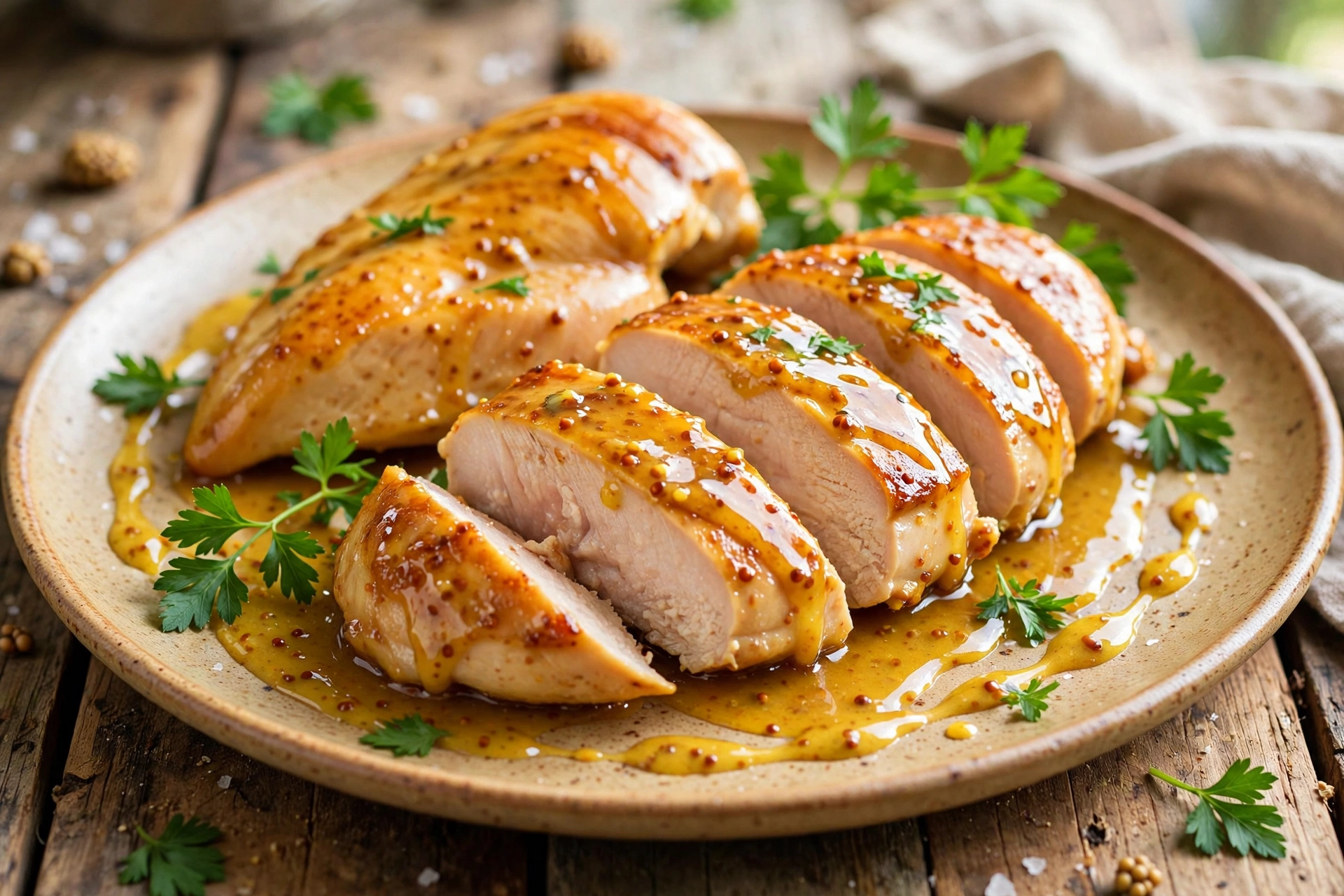
Alt text: Golden honey mustard chicken breasts sliced to show juicy meat, glazed with glossy wholegrain honey mustard sauce and fresh parsley — easy 30-minute honey mustard chicken dinner recipe
Ingredients
Everything on this list earns its place. The sauce is only five ingredients, and the chicken needs nothing more than salt, pepper, and a hot pan. Measure the sauce ingredients before you start cooking, because once the chicken hits the pan, things move fast.
- 4 boneless, skinless chicken breasts (about 1 1/2 lb total), pounded to an even 3/4-inch thickness
- 1 teaspoon kosher salt
- 1/2 teaspoon black pepper
- 2 tablespoons olive oil
- 1/3 cup honey
- 3 tablespoons Dijon mustard
- 2 tablespoons wholegrain mustard
- 3 cloves garlic, minced
- 1 tablespoon fresh lemon juice (from about 1/2 lemon)
- 1/4 teaspoon red pepper flakes (optional, for a gentle warmth)
- 2 tablespoons chopped fresh parsley, for garnish

Alt text: Flat-lay of honey mustard chicken ingredients on a wooden board — raw chicken breasts, honey, Dijon mustard, wholegrain mustard, garlic, olive oil, lemon, salt, pepper and parsley
Directions
Read the steps once before you start. The whole cook takes 20 minutes, and the order matters: sauce first, chicken second, garlic and sauce last. Honey burns quickly over high heat, which is why the sauce only goes into the pan once the chicken is nearly done.
Step 1: Whisk the honey mustard sauce (3 minutes)
In a small bowl, whisk together the honey, Dijon mustard, wholegrain mustard, lemon juice, and red pepper flakes if you are using them. Whisk until the mixture is smooth, glossy, and completely combined, with no streaks of mustard visible. Set the bowl right next to the stove so it is ready the second you need it. Taste it now and adjust: a little more honey if you want it sweeter, another teaspoon of Dijon if you want more tang. This is the easiest moment to fix the balance.
Step 2: Pound and season the chicken (4 minutes)
Pat the chicken breasts completely dry with paper towels. Dry chicken sears; wet chicken steams, and steamed chicken never gets that gorgeous golden crust. Place each breast between two sheets of parchment paper or inside a zip-top bag and pound gently with a meat mallet or rolling pin until each piece is an even 3/4 inch thick. Even thickness is the secret to even cooking: thin ends will not dry out while thick centers catch up. Season both sides generously with the salt and black pepper.
Step 3: Mince the garlic and chop the parsley (3 minutes)
Mince the garlic cloves finely and chop the parsley. Keep the garlic in its own little pile, separate from the parsley, because they go into the pan at different times. Garlic burns in under a minute if it hits a screaming-hot pan alone, so we add it only after the chicken is seared and the heat is under control. If you are serving this with mashed potatoes or green beans, get those going now so everything lands on the table at the same time.
Step 4: Sear the first side until deeply golden (6 minutes)
Heat the olive oil in a large skillet over medium-high heat until it shimmers and flows easily across the pan. Lay the chicken breasts in the pan in a single layer, leaving space between them, and do not touch them for a full 6 minutes. This is the hardest part of the recipe: leaving the chicken alone. That undisturbed contact is what builds the deep golden-brown crust, because the surface dries out and caramelizes instead of steaming. If you peek and lift a corner too early, you will see pale chicken. Wait, and you will see gold. After 6 minutes, the first side should be richly browned.
Step 5: Flip and sear the second side (5 minutes)
Flip each breast with tongs and sear the second side for 5 minutes. The chicken will not be fully cooked yet, and that is exactly right. It finishes in the sauce in the next step, which keeps it juicy instead of drying it out. While the second side sears, the pan will have lovely browned bits stuck to the bottom. Those little browned bits are flavor gold, and the sauce is about to lift every last one of them into the glaze.
Step 6: Add the garlic, pour in the sauce, and simmer (6 minutes)
Reduce the heat to medium. Push the chicken to one side of the pan and add the minced garlic to the empty space, stirring it for 1 minute until it smells fragrant but is still pale. Garlic turns bitter the moment it browns too far, so keep it moving and do not walk away. Pour the honey mustard sauce over the chicken and around the pan. It will bubble immediately and start to loosen all those browned bits from the bottom. Simmer for 5 minutes, spooning the sauce over the chicken once or twice, until the sauce has thickened into a glaze that coats the back of a spoon and the chicken reaches 165°F (74°C) at its thickest part when checked with an instant-read thermometer. The juices should run clear, with no pink remaining anywhere.
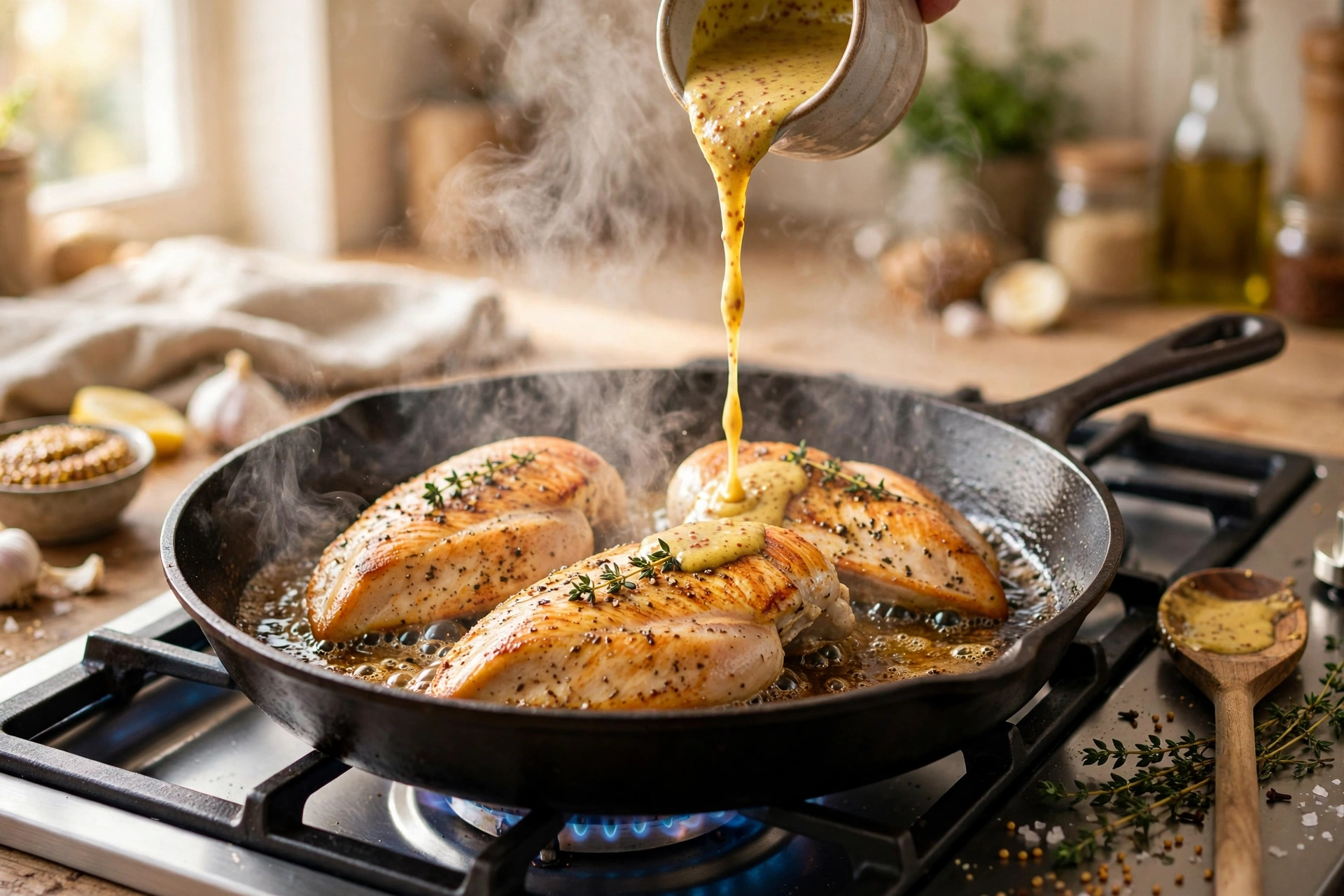
Alt text: Chicken breasts searing golden in a cast iron skillet while honey mustard sauce is poured over them, steam rising — easy one-pan honey mustard chicken cooking
Step 7: Rest, slice, and serve (3 minutes)
Transfer the chicken to a cutting board and let it rest for 3 minutes. Resting is not optional: the juices inside the chicken are still moving and settling, and slicing too soon lets them run out onto the board instead of staying in the meat. While the chicken rests, spoon any extra sauce from the pan over the top. Slice each breast against the grain into thick, even slices, arrange on plates, drizzle with the remaining pan sauce, and scatter the chopped parsley over the top. Serve hot with mashed potatoes, rice, or crusty bread to catch every drop of sauce.
Why This Honey Mustard Chicken Works
Great weeknight recipes are not accidents. They work because a few small technique choices stack up in your favor, and this one is built on four of them. Understanding the why makes the recipe yours, not just a set of instructions you follow once.
Two mustards, not one. Dijon mustard brings smooth, sharp tang and helps the sauce emulsify into a glossy glaze. Wholegrain mustard brings texture, little pops of mustard seed, and a rounder, milder heat. Used together, they give the sauce depth that a single mustard never reaches. This is the same layering idea behind classic honey mustard sauce, where sweet and sharp balance each other instead of one flavor shouting over the other. If you only have Dijon, the recipe still works, but the wholegrain is what makes people ask what is in the sauce.
A hard sear before any sauce touches the pan. Honey is mostly sugar, and sugar burns fast. If the sauce goes in while the pan is at full searing heat, the honey scorches and turns bitter before the chicken is cooked. So we sear the chicken naked first, building a deep golden crust through the Maillard reaction, the browning process that creates hundreds of savory flavor compounds on the surface of the meat. Only when the chicken is nearly done do we lower the heat and add the sauce, so the honey thickens into a glaze instead of burning into a bitter stain.
Even thickness means even cooking. A chicken breast is naturally thick on one end and thin on the other, which is a recipe for one dry end and one undercooked middle. Pounding to an even 3/4 inch fixes that in two minutes. Every part of the breast hits 165°F (74°C) at the same moment, so the whole piece stays juicy. It is the single highest-value step in the entire recipe, and it costs almost no time.
Finishing in the sauce, not drowning in it. The last five minutes of simmering do three jobs at once. The chicken finishes cooking gently in a moist environment instead of drying out in a hot pan. The sauce reduces and thickens until it clings to the chicken like a glaze. And the browned bits from searing dissolve into the sauce, folding all that roasted flavor back into every bite. Spooning the sauce over the chicken as it simmers is what lacquers the top so beautifully. That glossy finish is not decoration; it is flavor, and it is the reason the sliced chicken on the plate looks like it came from a restaurant kitchen.
If you love this style of cooking, our one-pan garlic butter chicken and rice uses the same sear-then-simmer logic with a buttery garlic sauce, and our chicken lo mein is another 30-minute chicken dinner that leans on a glossy sauce to do the heavy lifting. And if you enjoy the sweet-savory balance of mustard and honey, our maple Dijon roasted chicken breast is the oven-roasted cousin of this recipe, with the same tangy-sweet personality in a hands-off roast.
Pro Tips for the Best Honey Mustard Chicken
- Use a thermometer, not a guess. Chicken breasts are done at 165°F (74°C) at the thickest part. Pulling them at exactly 165°F keeps them juicy; guessing usually means overcooking by 10 degrees and dry chicken. An instant-read thermometer is the cheapest insurance in your kitchen.
- Do not crowd the pan. Four breasts need a large 12-inch skillet with breathing room between them. If they are touching, moisture gets trapped and the chicken steams instead of searing. If your pan is small, sear in two batches and add all the chicken back for the sauce step.
- Pat the chicken very dry. Surface moisture is the enemy of browning. Two paper towels and ten seconds of patting are the difference between a pale, rubbery surface and a deep golden crust.
- Let the pan get hot before the chicken goes in. The oil should shimmer and flow like water. If the chicken does not sizzle loudly the moment it touches the pan, the pan is not ready. Pull the chicken out, wait another minute, and try again.
- Taste the sauce before it hits the pan. Honey varies in sweetness, and Dijon varies in sharpness. The 30 seconds you spend adjusting the sauce in the bowl is the only chance to fix the balance. Once it is simmering around the chicken, your options narrow fast.
- Slice against the grain. Look for the lines running through the cooked breast and cut across them, not along them. Short fibers mean tender bites; long fibers mean chewy ones. This tiny detail makes a real difference in how juicy the chicken feels.
- Save every drop of pan sauce. The sauce left in the skillet is liquid gold. Spoon it over the chicken, over mashed potatoes, or over rice. If there is barely any left, a splash of chicken broth swirled into the hot pan will lift the last of it.
Common Mistakes to Avoid
- Adding the sauce too early. Honey burns at high heat. If the sauce goes in while the pan is still at searing temperature, it scorches, turns bitter, and sticks in a dark, acrid layer. Sauce goes in only after the heat comes down to medium and the chicken is nearly cooked.
- Moving the chicken while it sears. Lifting, poking, and shuffling the breasts breaks the contact that builds the crust. Place them down, set a timer for 6 minutes, and let the pan do its work. The chicken will release from the pan on its own when the crust is ready.
- Skipping the pounding step. An uneven breast cooks unevenly, full stop. The thin end dries out while the thick middle is still pink, and no amount of sauce can fix that texture gap.
- Burning the garlic. Garlic goes from fragrant to bitter in about 60 seconds over medium heat. Add it only after the heat is lowered, stir it constantly, and pour the sauce in the moment it smells sweet and nutty.
- Cooking by time alone. Breast sizes vary wildly, and a thick breast needs more time than a thin one. Time is a guide; the thermometer is the truth. Check at the thickest part, and trust 165°F (74°C) over the clock.
- Slicing straight out of the pan. Cutting into hot chicken sends the juices running across the board. Three minutes of rest keeps them in the meat, where they belong. Tent the chicken loosely with foil while it rests so it stays warm.
- Using cold chicken straight from the fridge. Ice-cold breasts hit a hot pan and drop the temperature, which means steaming instead of searing. Let the chicken sit on the counter for 10 to 15 minutes while you whisk the sauce and prep the garlic, and the sear will be far better.
Easy Substitutions
- Chicken thighs: Boneless, skinless thighs work beautifully and are even harder to dry out. Sear 7 to 8 minutes per side instead of 6 and 5, and still finish at 165°F (74°C) internal temperature. The sauce and times for simmering stay the same.
- Only Dijon on hand: Use 5 tablespoons of Dijon and skip the wholegrain. The sauce will be smoother and sharper; add an extra teaspoon of honey to round it out. A spoonful of yellow mustard can stand in for wholegrain in a pinch, though the texture will be smoother.
- Maple syrup instead of honey: Swap in the same amount of pure maple syrup for a deeper, woodsy sweetness. The sauce will be slightly thinner, so let it simmer an extra minute to thicken.
- No fresh lemon: A tablespoon of apple cider vinegar gives the same bright lift. Bottled lemon juice works too, though fresh tastes noticeably brighter.
- Dairy-free and gluten-free: This recipe is naturally both, as written. Just double-check that your mustards are certified gluten-free if you are cooking for someone with celiac disease, since a few brands add gluten-containing thickeners.
- Want more heat: Add 1/2 teaspoon of chili flakes or a teaspoon of hot sauce to the sauce. A pinch of cayenne works too. The honey keeps the heat friendly rather than fierce.
- Fresh herbs: Parsley is classic, but chopped chives or a little fresh thyme are lovely too. Add delicate herbs at the very end so they stay bright and green.
Storage and Make-Ahead
Leftovers are one of the best parts of this recipe, because the chicken actually gets more flavorful as it sits in the sauce overnight. Cool the chicken completely, then store it in an airtight container with all the pan sauce poured over the top. It keeps in the refrigerator for 3 to 4 days. The two-hour rule applies here as always: do not leave cooked chicken sitting out at room temperature for more than 2 hours before refrigerating it.
To reheat, warm the chicken gently in a covered skillet over medium-low heat with a splash of chicken broth or water, about 5 minutes, until it reaches 165°F (74°C) again. The microwave works too: cover the plate, heat in 45-second bursts, and stop as soon as it is hot through, since overheating is what dries out reheated chicken. The sauce will loosen as it warms and gloss up again beautifully.
For freezing, place cooled chicken and sauce in a freezer-safe container or bag and freeze for up to 3 months. Thaw overnight in the refrigerator, then reheat gently as above. The sauce may look slightly separated after thawing; a good stir while it warms brings it back together. The sauce alone, without the chicken, also freezes well and makes a fantastic quick glaze for pork chops or roasted vegetables later in the week.
If you want to get ahead, whisk the sauce up to 3 days in advance and keep it in a jar in the fridge. On cooking day, all you have to do is pound, season, sear, and simmer. You can also pound and season the chicken the night before; keep it covered in the refrigerator and let it sit at room temperature for 10 to 15 minutes before it hits the pan. For nutrition details on the chicken itself, the USDA FoodData Central database at fdc.nal.usda.gov lists values for cooked chicken breast, which is a handy reference when you are planning the rest of the plate.

Alt text: Sliced honey mustard chicken served with creamy mashed potatoes and green beans, drizzled with glossy honey mustard sauce and parsley — easy 30-minute family dinner
Frequently Asked Questions
Can I use chicken thighs instead of chicken breasts?
Yes, boneless skinless thighs are a great swap and stay juicy even if they cook a minute or two longer. Sear them 7 to 8 minutes per side, then simmer in the sauce the same way, and check that they reach 165°F (74°C) at the thickest part. Bone-in thighs also work, but they need about 10 minutes per side and a longer simmer, so the total time stretches closer to 40 minutes.
Can I make honey mustard chicken ahead of time?
Yes. Cook it fully, cool it within 2 hours, and refrigerate it in its sauce for up to 4 days. The flavor actually deepens overnight. Reheat gently in a covered skillet over medium-low heat with a splash of broth until it reaches 165°F (74°C). The sauce can also be whisked up to 3 days ahead and kept in a jar in the fridge, which makes the cooking night almost effortless.
How do I keep the honey mustard sauce from burning?
Keep the sauce out of the pan until the heat is down to medium and the chicken is nearly cooked. Honey scorches quickly over high heat, so the sauce only simmers for the last 5 minutes. If the pan looks too hot when you pour the sauce in, pull it off the burner for 30 seconds first. Stirring the sauce as it simmers and spooning it over the chicken keeps it moving and prevents any one spot from catching.
What should I serve with honey mustard chicken?
Anything that can soak up the sauce is a winner. Creamy mashed potatoes and steamed green beans are the classic pairing, and fluffy rice, buttered egg noodles, or crusty bread all work beautifully. For a lighter plate, serve it over a crisp green salad or with roasted carrots and a simple cucumber salad. The pan sauce doubles as a dressing for whatever sits underneath the chicken.
Rate this recipe
Be the first to rate it!
1 thought on “Easy Honey Mustard Chicken”