
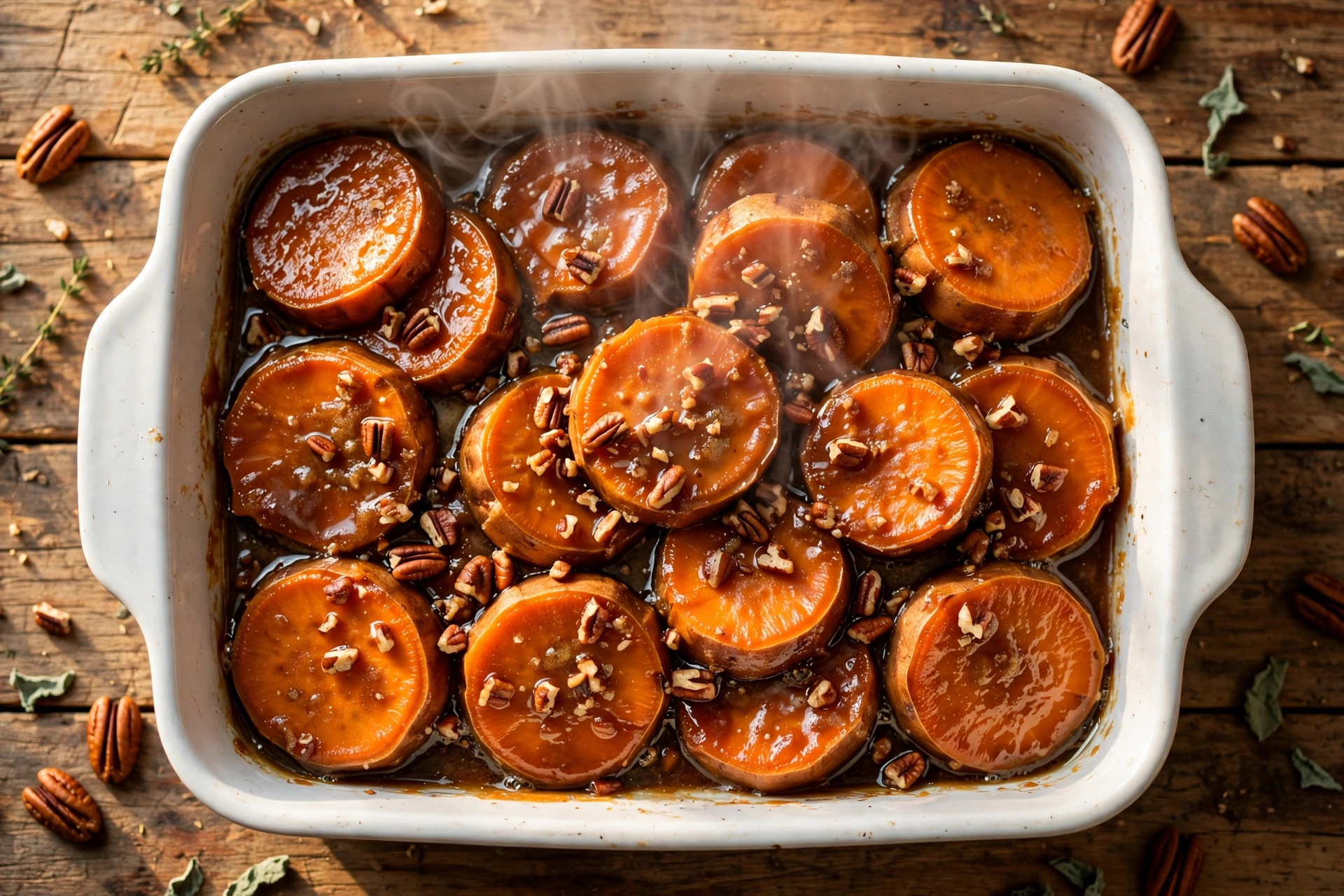
There is a moment at every Thanksgiving dinner when the turkey gets carved, the rolls get passed around, and then somebody reaches for the candied yams and the whole table goes quiet for a second. Not because anyone is being polite. Because the first bite is that good. Soft, buttery orange rounds of yam, glossy with a brown sugar glaze that tastes like caramel and cinnamon had a baby, with a little crunch of pecans on top. These easy candied yams are that dish, and they take about an hour from start to finish, most of it hands-off while the oven does the work.
Here is the thing nobody tells you about candied yams: they look like a dish that took all afternoon, and they taste like a dish somebody’s grandmother guarded for decades, but the whole recipe is just eight ingredients and one baking dish. The secret is not a fancy technique. It is the method. Yams sliced evenly so every piece cooks at the same pace. A quick brown sugar and butter glaze melted on the stove, so the sugar dissolves before it ever meets the oven and never turns gritty. Thirty minutes covered, so the yams steam themselves tender, then fifteen minutes uncovered, so the glaze bubbles down into a thick syrup that coats every slice. That is the whole trick, and it works every single time.
What you get for that hour is the side dish that disappears first at Thanksgiving, at Christmas dinner, at Sunday roasts, and at every potluck in between. Tender yams with edges that catch the glaze and turn sticky-sweet, warm cinnamon in every bite, and a buttery sauce that people will spoon over their turkey without even thinking about it. Make the full batch even if your table is small, because leftover candied yams reheat beautifully and somebody will be asking for the recipe before dessert.
And here is the best part for the cook: the whole thing is done in 60 minutes, and only about ten of those minutes ask anything of you. Ten minutes of peeling and slicing, one minute of stirring a glaze, and then the oven takes over while you get on with the turkey, the table, or a quiet cup of coffee. There is no babysitting, no fussy technique, and no last-minute rush. When the timer goes off, you pull out a dish that looks like you worked on it all day. That is the kind of recipe that earns a permanent spot in the holiday rotation, and this one has earned its place on ours.
Why This Recipe Works
Candied yams are simple, but the difference between glossy, spoon-licking yams and a watery, bland pan comes down to three small decisions. Get these right and the recipe is nearly impossible to mess up.
First, the slices. Cut your yams into even rounds about half an inch thick, and every piece finishes at the same moment: tender all the way through, with no mushy edges and no crunchy centers. Cut them too thick and the middles stay firm while the glaze overcooks. Cut them too thin and they collapse into mush before the glaze has time to thicken. Half an inch is the sweet spot, and it is worth the extra minute with the knife.
Second, the cover-then-uncover bake. The foil goes on for the first thirty minutes for a reason. Trapped steam gently cooks the yams through without drying them out, and the sugar melts into the butter instead of scorching. Then the foil comes off for the last fifteen minutes, and that is when the magic happens: the liquid in the pan bubbles and reduces, the glaze turns thick and syrupy, and the exposed edges of the yams caramelize just a little. Skip the covered stage and the yams dry out. Skip the uncovered stage and you get yams swimming in thin, watery liquid instead of a glossy glaze.
Third, the rest. Five minutes on the counter after the dish comes out of the oven is not optional, and it is the easiest step in the whole recipe. As the glaze cools slightly it thickens and clings to the yams instead of pooling at the bottom of the dish. Spoon it over the top right before serving and every slice shines.
One honest note about the name, because it confuses almost everyone at the grocery store. The orange-fleshed roots sold as yams in most American supermarkets are actually sweet potatoes, usually garnet or jewel varieties. True yams are a different vegetable entirely, starchier and drier, and they are rarely what you find in the produce aisle in November. For this recipe, reach for the ones labeled yams or garnet yams at the store, the ones with coppery skin and deep orange flesh. If you want the full background, Wikipedia’s yam page explains the difference between true yams and the sweet potatoes Americans call yams. Either way, what matters is the orange flesh, because that is where the natural sweetness lives. Sweet potatoes are also a genuinely nourishing choice for a holiday side: the USDA FoodData Central database lists them as rich in vitamin A from beta-carotene, along with fiber and potassium, which is a nice bonus for a dish that tastes like dessert.
Recipe at a Glance
- Prep Time: 10 minutes (peeling and slicing the yams, melting the glaze)
- Cook Time: 45 minutes (30 minutes covered, 15 minutes uncovered)
- Rest Time: 5 minutes (so the glaze thickens and clings to the yams)
- Total Time: 60 minutes
- Serves: 6 (about 1 cup per serving, as a holiday side dish)
- Yield: 6 servings
- Course: Side dish
- Cuisine: American classic, Thanksgiving table
- Diet: Gluten-free, vegetarian
- Equipment: 9×13-inch baking dish, vegetable peeler, sharp knife, small saucepan, aluminum foil, serving spoon
Ingredients
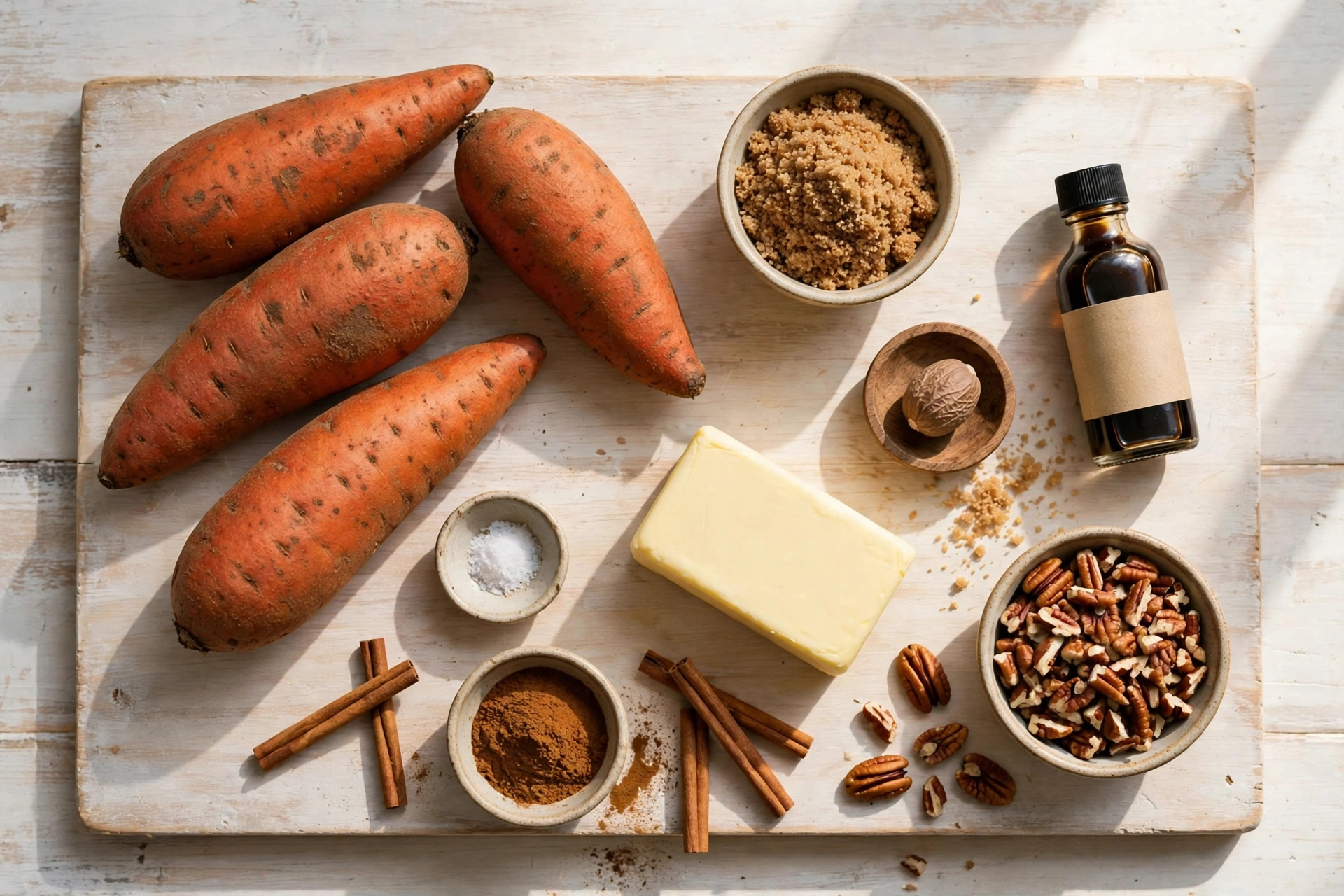
Eight ingredients, and you probably have half of them in the pantry already. Use real butter, not margarine, because the glaze needs butter’s flavor to taste like caramel instead of just sweet. Use light brown sugar for a gentle molasses note, and do not skip the pinch of salt: it is the ingredient that makes the sweetness taste rounder instead of flat. The quantities below make six generous servings, enough for a holiday table of six.
- 4 medium garnet yams, about 2 pounds (900 g), peeled
- 1/2 cup packed light brown sugar (100 g)
- 4 tablespoons unsalted butter (57 g)
- 1 teaspoon ground cinnamon
- 1/4 teaspoon ground nutmeg
- 1 teaspoon vanilla extract
- 1/4 teaspoon fine sea salt
- 1/3 cup chopped pecans, for serving
Directions
- Preheat and prep the dish. Heat the oven to 375°F (190°C). Butter a 9×13-inch baking dish generously, getting into the corners so the glaze never sticks. This also adds a little extra buttery flavor to the edges of the dish, which nobody has ever complained about.
- Slice the yams. Peel the yams and slice them into even rounds about 1/2 inch thick. Arrange the rounds in the buttered dish in slightly overlapping rows, like shingles on a roof. Overlapping is not just pretty: it keeps the slices snug so they steam evenly, and it gives the glaze more surface to cling to.
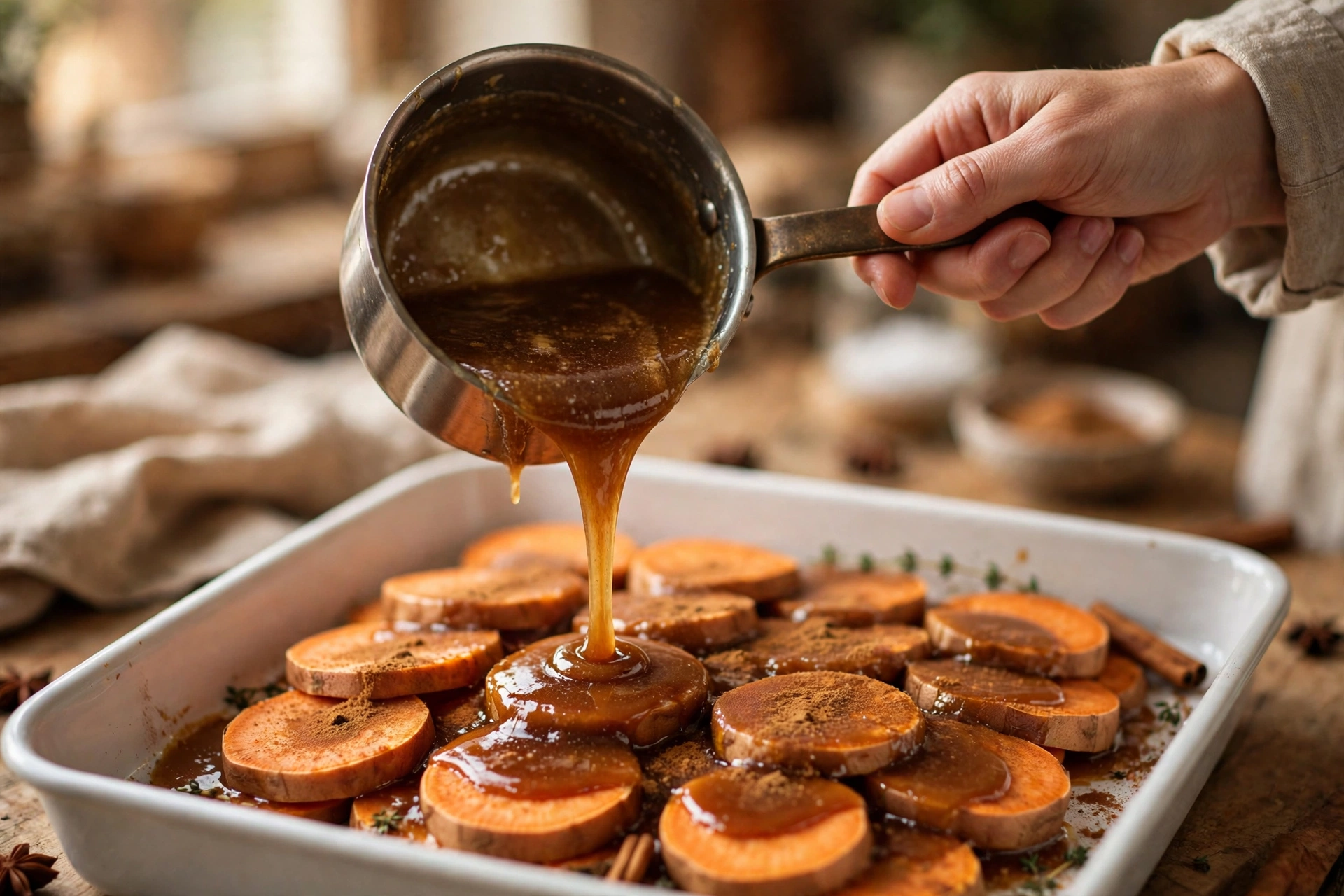
- Make the glaze. Melt the butter in a small saucepan over medium heat. Stir in the brown sugar, cinnamon, nutmeg, vanilla, and salt. Cook, stirring constantly, for about 1 minute, until the sugar has dissolved and the mixture is bubbling gently and smells like warm caramel. Take it off the heat the moment it bubbles. Sugar goes from dissolved to scorched fast, so do not walk away from the pan.
- Glaze and cover. Pour the hot glaze evenly over the yam slices, then use a spoon to nudge any dry spots until every slice has a glossy coating. Cover the dish tightly with aluminum foil, crimping the edges so no steam escapes.
- Bake covered for 30 minutes. Slide the dish into the oven and bake, covered, for 30 minutes. The trapped steam does the gentle work here, cooking the yams through while the sugar and butter melt into a sauce around them. Resist the urge to peek: every time the foil lifts, steam escapes and the yams take longer.
- Uncover, baste, and bake 15 minutes more. Carefully pull off the foil and spoon the pan juices over the yams. Bake uncovered for 15 minutes more, until the yams are completely fork-tender and the glaze has bubbled down into a thick syrup that coats the back of a spoon. A knife should slide through a slice with zero resistance. If the glaze still looks thin, give it another 5 minutes uncovered and check again.
- Rest for 5 minutes. Pull the dish out of the oven and let it sit on the counter for 5 minutes. The glaze thickens as it cools just slightly, turning from runny to syrupy and clinging to every slice. Spoon the glaze from the bottom of the dish over the top before serving.
- Garnish and serve. Sprinkle the chopped pecans over the top and serve the yams warm, straight from the baking dish, with a spoon for the extra glaze. The pecans add the one thing the dish is missing on its own: a little crunch against all that soft, buttery sweetness.
Tips for the Best Candied Yams
Pick yams that feel heavy for their size with smooth, unblemished skin. Heavy means dense, moist flesh, and that is what turns tender and creamy in the oven instead of dry and stringy. Avoid any with soft spots or sprouts. Four medium yams should weigh about 2 pounds total; if yours are very large, three will do, and if they are small, grab five. A quick weigh on the kitchen scale before you start saves you from guessing at the produce stand.
Slice with a sharp knife and take your time. Even slices are the single biggest factor in how this dish turns out, and a dull knife that crushes the flesh instead of cutting it cleanly will give you ragged edges that overcook. If you have a mandoline, this is the moment to use it, with the guard on.
Do not use dark brown sugar unless you truly love molasses. Light brown sugar gives the glaze its caramel warmth without pushing it toward bitter. And measure the sugar packed into the cup, not scooped loosely, because a loosely filled cup can be a quarter cup short and the glaze will come out thin.
Toast the pecans if you have three spare minutes. A dry skillet over medium heat, pecans in a single layer, shaking the pan until they smell nutty, about 2 to 3 minutes. It deepens their flavor enormously and keeps them crunchy longer once they hit the warm glaze. Let them cool before sprinkling so they do not soften.
Butter the dish well, even if it feels like overkill. The glaze gets sticky as it reduces, and a well-buttered dish is the difference between serving beautiful glossy slices and scraping caramelized sugar off ceramic with a spatula.
Bake on the center rack so the top and bottom of the dish cook evenly, and if your oven runs hot, check the yams at 25 minutes into the covered bake rather than waiting for the full 30. A few ovens run a full 25 degrees hotter than the dial says, and catching that early is much easier than rescuing scorched glaze later. An inexpensive oven thermometer is the quiet hero of holiday baking, and this is the dish that proves it.
Feeding a crowd? The recipe doubles beautifully, but use two 9×13-inch dishes instead of one enormous pan. A doubled batch crammed into a single deep dish steams instead of glazing, and the middle slices never get that sticky, caramelized edge. Two dishes side by side in the oven, swapped halfway through if your oven has hot spots, will feed twelve just as easily as one feeds six.
Common Mistakes to Avoid
The most common mistake is slicing unevenly. A pan with half-inch rounds and one-inch chunks will give you half the yams falling apart and half still firm in the middle, and no amount of extra baking fixes that without ruining the thin ones. Take the extra minute and measure the first few slices against each other.
The second mistake is skipping the covered bake or pulling the foil off too early. Without that steam, the yams dry out on top while the bottoms sit in liquid, and the glaze never gets the chance to soak in. Thirty minutes covered is not a suggestion. It is the step that makes the dish.
The third mistake is judging the glaze while it is still piping hot. Fresh out of the oven the glaze always looks thinner than it is. Give it the full five-minute rest before deciding it needs more time. If it is genuinely still thin after resting, slide the uncovered dish back into the oven for 5 more minutes, but check it at 3: glaze goes from syrupy to scorched faster than you would think.
Finally, do not add water to the pan. It feels like insurance against sticking or burning, but it is the fastest way to a watery glaze. The butter and the moisture from the yams themselves are all the liquid this dish needs.
Substitutions
No pecans? Chopped walnuts work just as well, and so do toasted hazelnuts if you want something a little fancier. Leave the nuts off entirely and the dish is still wonderful, just softer. For a nut-free table, a sprinkle of toasted pumpkin seeds adds crunch without the allergy worry.
Out of fresh yams? Canned yams or canned sweet potatoes in syrup will work in a pinch, but drain them very well first and cut the bake time down to about 20 minutes uncovered, since they are already fully cooked. Reduce the brown sugar to 1/4 cup too, because canned yams arrive already sweet.
Want a warmer spice profile? Add a pinch of ground ginger or a tiny pinch of ground cloves to the glaze along with the cinnamon. Both are classic Thanksgiving spices and they play beautifully with brown sugar. Keep the amounts small, though: a little clove goes a long way and can take over the whole dish.
For a dairy-free version, swap the butter for the same amount of coconut oil or a good vegan butter. Coconut oil adds a faint tropical note that actually suits the glaze, and the dish stays just as glossy. Use a plant-based butter if you want the flavor to stay neutral.
Maple syrup lovers can swap 2 tablespoons of the brown sugar for pure maple syrup. It deepens the caramel flavor and adds a whisper of maple that makes the whole dish taste a little more like fall. Do not swap all the sugar, though: brown sugar is what gives the glaze its body.
Storage and Make-Ahead
Leftover candied yams keep in the fridge for 3 to 4 days in an airtight container, and they reheat beautifully. Warm them in a 350°F oven, covered with foil, for about 15 minutes, or microwave individual portions for 1 to 2 minutes, spooning the glaze over the top as they heat. Add the pecans fresh after reheating so they stay crunchy.
Do not freeze candied yams if you can help it. The glaze thins out as it thaws and the yams turn soft and watery, losing the tender-but-intact texture that makes the dish. If you must freeze them, use them within a month and expect to reheat them gently, but the fridge is a far better home for leftovers.
Like any cooked side dish, do not leave candied yams sitting out at room temperature for more than 2 hours. At a holiday buffet, that means enjoying them during dinner and getting the leftovers into the fridge before the pie comes out.
For make-ahead planning, assemble the whole dish the day before: slice the yams, make the glaze, pour it over, cover tightly, and refrigerate. On the day, let the dish sit on the counter for 20 minutes while the oven preheats, then bake as directed, adding about 5 extra minutes to the covered bake since the dish starts cold. You can also bake the yams fully a day ahead and reheat them covered at 350°F for 20 minutes, spooning the glaze over the top before serving. The pecans always go on last, right before the dish hits the table.
Serving Ideas
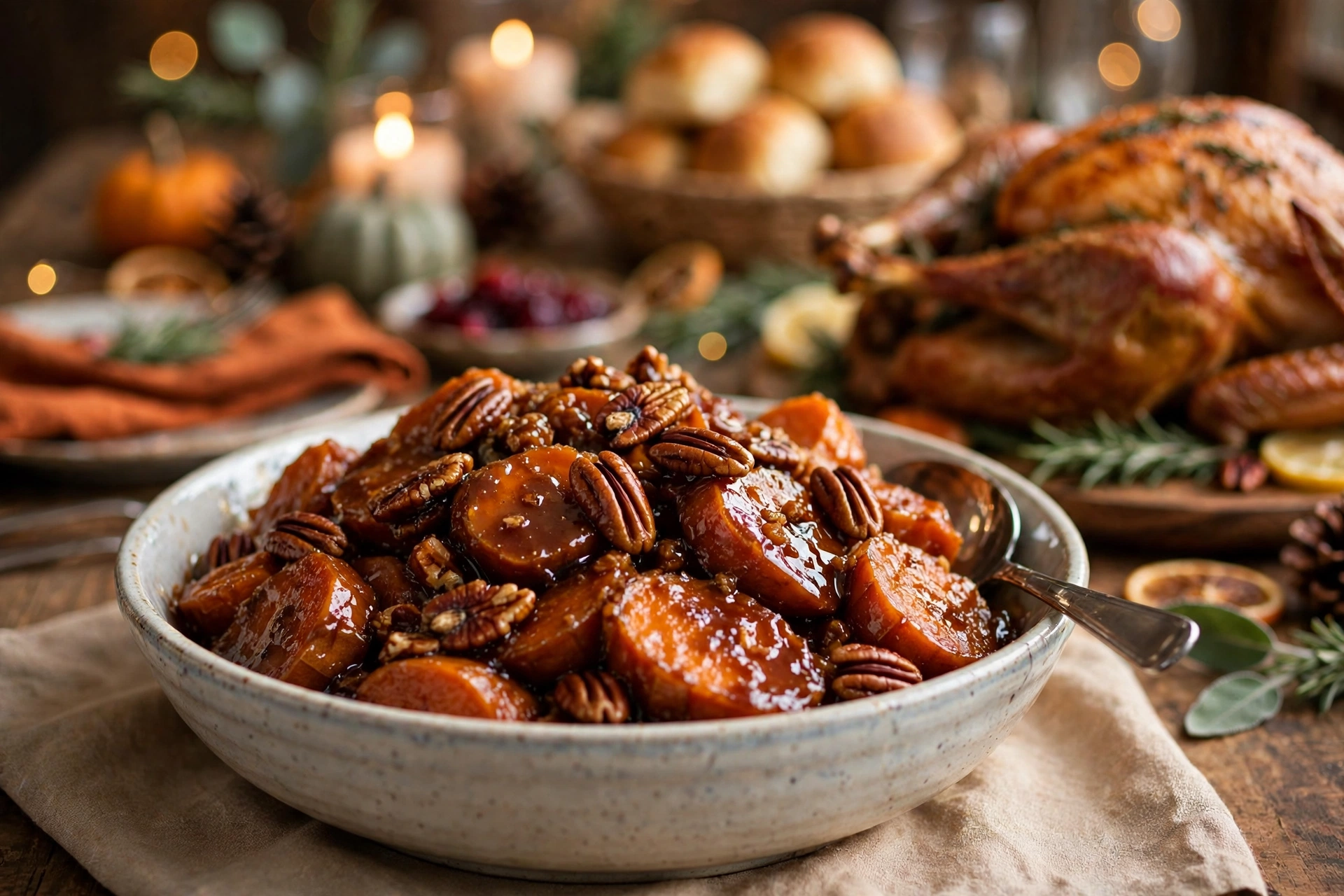
Candied yams were born for the Thanksgiving table, and they sit happily next to roast turkey, stuffing, and cranberry sauce, soaking up a little gravy on the side of the plate without complaint. If you are building the full holiday spread, our easy maple roasted Brussels sprouts bring a savory, caramelized counterpoint to all that sweetness, and a basket of warm easy dinner rolls is there for mopping up every last drop of glaze.
Beyond the holidays, candied yams are wonderful with baked ham, roast chicken, or pork chops on a regular Sunday. Their sweetness plays the same role as applesauce with pork: a sweet, soft contrast that makes the savory main taste even better. They also work at a potluck, because they travel well in their baking dish and reheat in any oven.
If your family is the marshmallow-topped kind, and some families absolutely are, our sweet potato casserole with marshmallows is the dish for that craving, with a gooey toasted topping over creamy mashed sweet potatoes. The candied yams here are its sleeker cousin: sliced, glazed, and a little more grown-up, with pecans instead of marshmallows.
Do not overlook the leftovers, either. Cold candied yams, chopped and folded into morning oatmeal with a spoonful of yogurt, taste like a dessert you are allowed to eat for breakfast. Warmed and spooned over vanilla ice cream, they turn into a five-minute holiday dessert that nobody will believe came from a side dish. The glaze is the secret in both cases: it is essentially a brown sugar caramel sauce, and it is far too good to waste on one meal alone.
Frequently Asked Questions
Are candied yams and sweet potatoes the same thing?
In American grocery stores, yes, for practical purposes. The coppery-skinned, orange-fleshed roots sold as yams are actually sweet potatoes, usually garnet or jewel varieties. True yams are a different vegetable, starchier and drier, and rarely sold in US supermarkets. For this recipe, buy the ones labeled yams or garnet yams and you will get exactly the sweet, tender result you want.
Can I make candied yams ahead of time?
Yes. Assemble the dish up to a day ahead: slice the yams, pour over the glaze, cover tightly, and refrigerate. On serving day, let the dish sit at room temperature for 20 minutes, then bake as directed, adding about 5 minutes to the covered bake since it starts cold. Or bake the yams fully a day ahead and reheat covered at 350°F for 20 minutes, adding the pecans just before serving.
Why are my candied yams watery?
The most common causes are slicing the yams too thick, skipping the uncovered bake, or judging the glaze before it rests. Thick slices release more water as they cook, the uncovered stage is what reduces the liquid into syrup, and the glaze thickens noticeably during the 5-minute rest. Bake uncovered 5 minutes longer next time, let the dish rest the full 5 minutes, and do not add any water to the pan.
Can I use canned yams for candied yams?
Yes, canned yams or canned sweet potatoes work in a pinch. Drain them very well, reduce the brown sugar to 1/4 cup since they arrive already sweet, and bake uncovered for about 20 minutes, just until the glaze is bubbling and syrupy. They are already fully cooked, so they only need to heat through and soak up the glaze.
Rate this recipe
Be the first to rate it!