
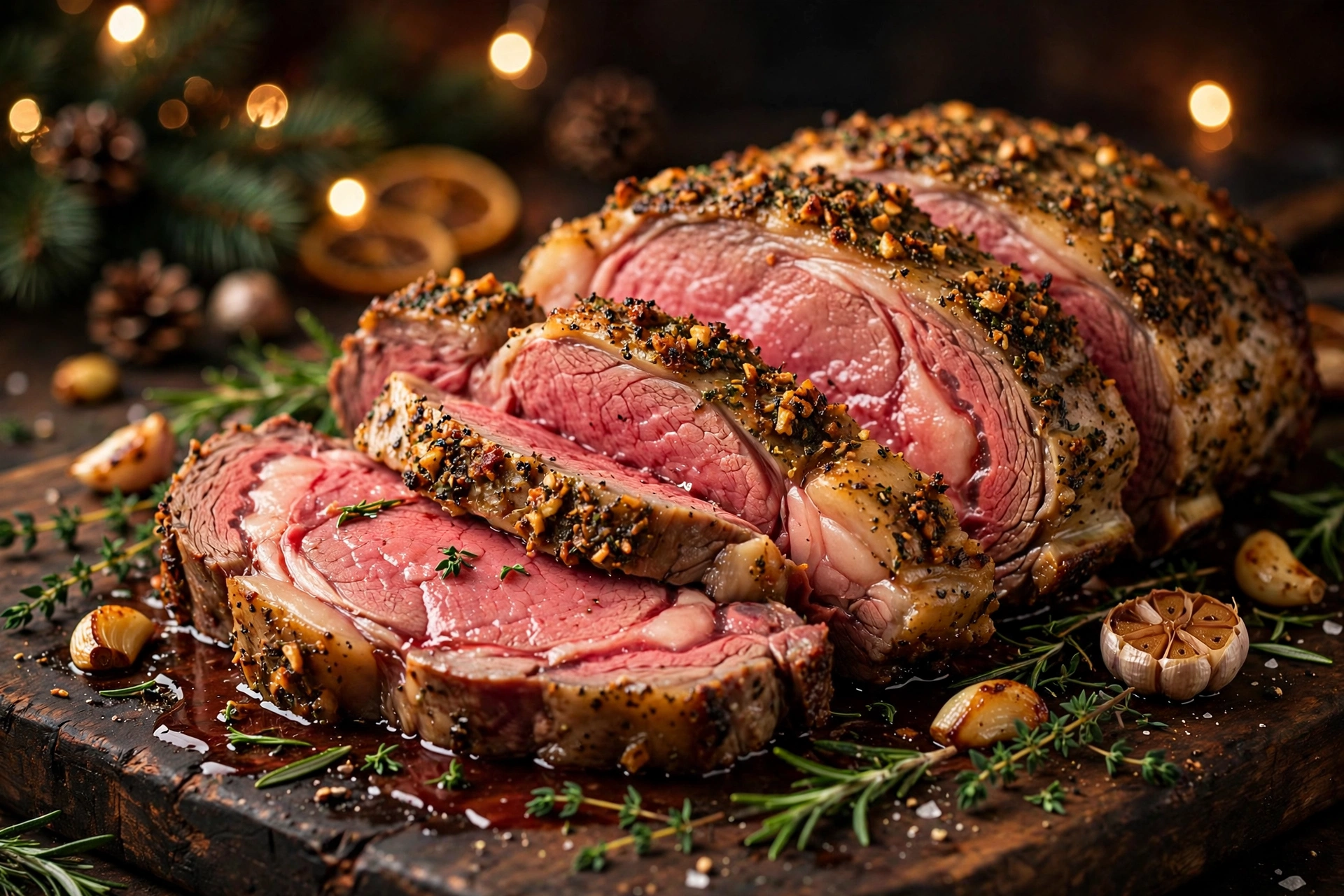
There is a special kind of silence that falls over a holiday dinner table when the prime rib arrives. It is the sound of every guest quietly realizing that tonight is going to be good. The platter lands, candles flickering, and there it is: a deeply browned roast glistening with its garlic-herb crust, sliced to reveal a blushing pink center so juicy it practically winks at you. This Foolproof Garlic Herb Prime Rib is exactly that moment, bottled into a recipe anyone can nail on the first try.
Let us be honest: prime rib has a reputation. People call it intimidating, expensive, easy to ruin. And sure, it costs more than a weeknight chicken, but that is exactly why you want a method that removes every ounce of guesswork. This is a low-and-slow roast, a fragrant garlic and fresh-herb paste, and one sacred rule: pull the roast at 140 degrees, let it rest twenty minutes, and it coasts to a food-safe, perfectly pink 145 degrees all by itself. No searing, no fussing, no standing over the oven with a prayer. About 5 hours 40 minutes from counter to table, most of it hands-off, and you walk into the dining room looking like a holiday legend.
Whether it is Christmas dinner, a New Year celebration, or the Sunday when you finally invite the whole family over, this recipe delivers edge-to-edge rosy meat, a crackling savory crust, and a creamy horseradish sauce that guests will talk about long after the plates are cleared. Grab the thermometer, and let us make some magic.
Recipe at a Glance
- Prep time: 20 minutes (plus 2 hours tempering the roast at room temperature)
- Cook time: about 3 hours at 275°F (pull at 140°F internal)
- Rest time: 20 minutes tented loosely with foil (carryover heat brings it to 145°F)
- Total time: about 5 hours 40 minutes
- Yield: 8 servings (one 5-pound bone-in standing rib roast, 3 ribs)
- Oven temperature: 275°F, low and slow
- Target final internal temperature: 145°F (USDA recommended minimum for whole beef cuts, with a 3-minute rest)
Ingredients
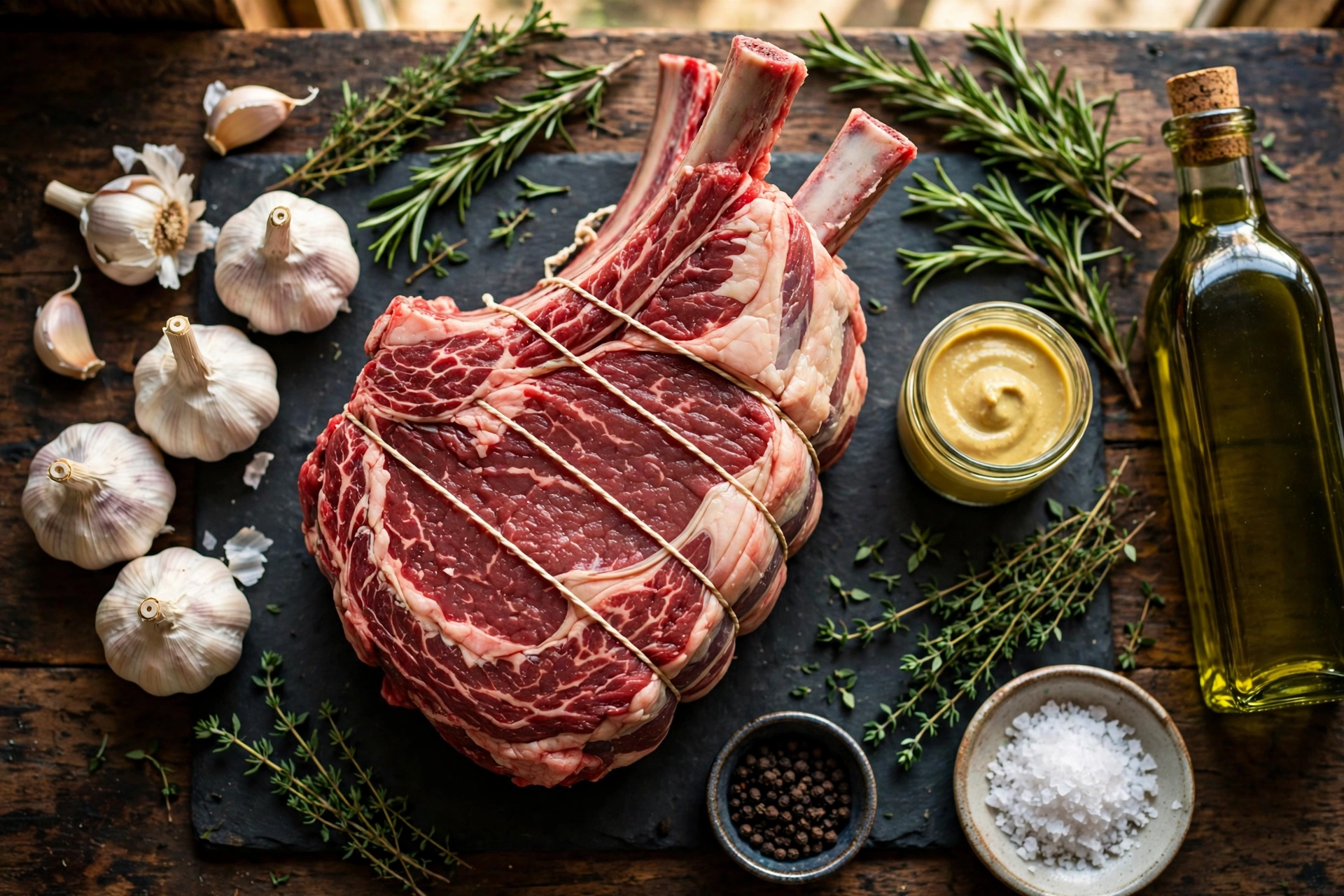
- 1 (5-pound) bone-in standing rib roast, 3 ribs, patted completely dry with paper towels
- 2 tablespoons coarse kosher salt
- 2 teaspoons freshly ground black pepper
- 8 cloves garlic, minced (about 1/4 cup)
- 2 tablespoons fresh rosemary, finely chopped
- 2 tablespoons fresh thyme leaves, finely chopped
- 2 tablespoons Dijon mustard
- 1/4 cup olive oil
- 1/4 cup unsalted butter, softened to room temperature
Creamy Horseradish Sauce
- 1/2 cup sour cream
- 3 tablespoons prepared horseradish, drained
- 1 teaspoon Dijon mustard
- 1 tablespoon chopped fresh chives
- 1/4 teaspoon fine sea salt
Directions
- Temper the roast. Set the prime rib on a rimmed baking sheet and leave it at room temperature for 2 hours. A cold roast cooks unevenly; a tempered one roasts gently from edge to center. (Perishable meat should never sit out longer than 2 hours, so set a timer.)
- Heat the oven. Position a rack in the lower third of the oven and preheat to 275°F. Set the roast bone-side down on a roasting rack inside a heavy roasting pan so the meat stands up on its bones, away from the pan surface.
- Season boldly. Rub the entire roast, top, sides and ends, with the kosher salt and black pepper. Prime rib is a big cut; it needs assertive seasoning to reach the center of every slice.
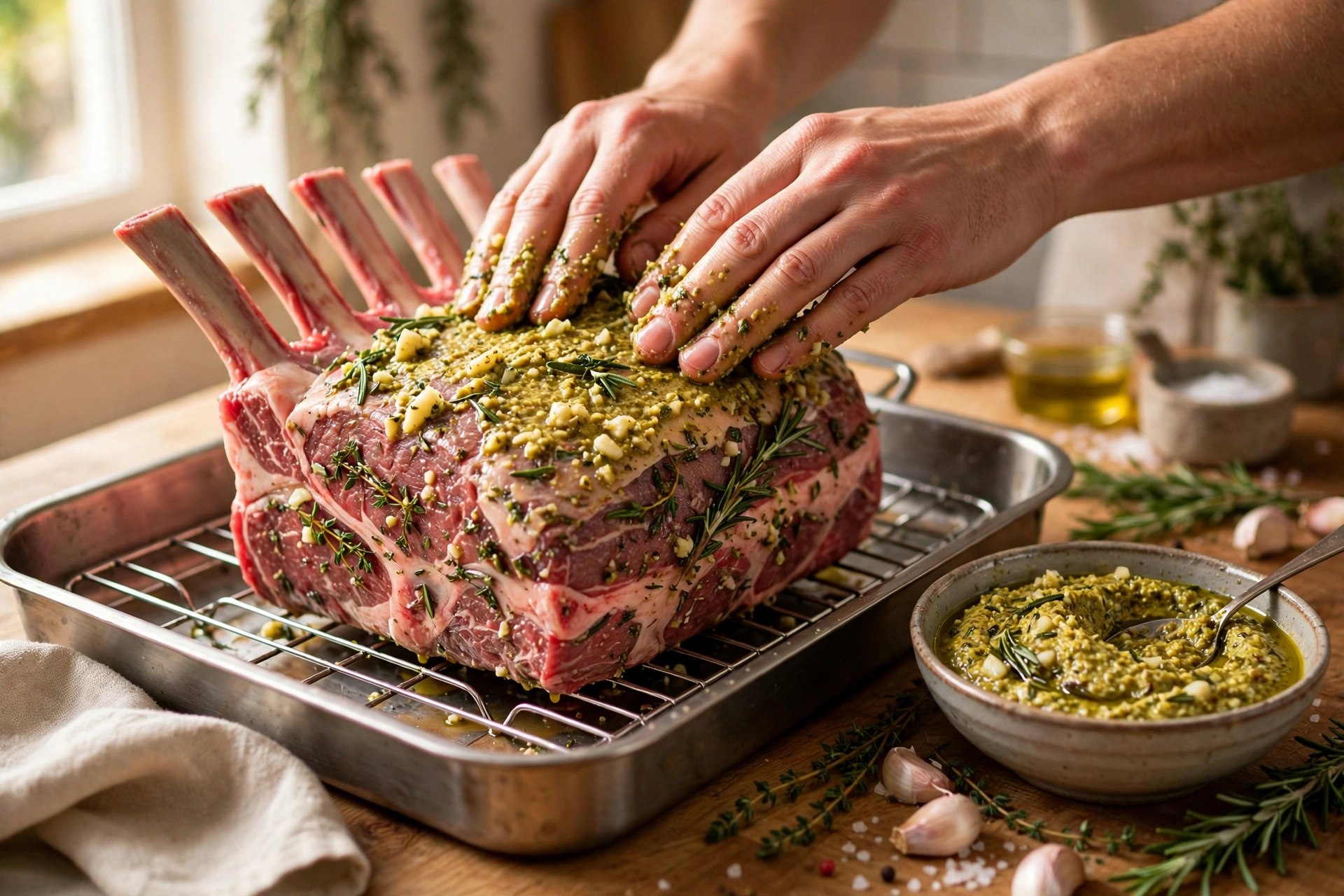
- Build the garlic-herb paste. In a small bowl, mash together the minced garlic, chopped rosemary, thyme, Dijon mustard, olive oil and softened butter into a thick, fragrant paste. The butter carries the herbs and helps the crust brown to a deep golden mahogany.
- Slather it on. Spread the paste in an even, generous layer over the top, sides and ends of the roast, pressing it in so it clings. A few garlic bits peeking through is perfect.
- Roast low and slow. Slide the pan into the oven and roast for about 3 hours, until an instant-read thermometer in the thickest part of the eye (not touching bone) reads 140°F. Start checking at the 2 hour 45 minute mark. Temperature is the only doneness clock that matters.
- Rest without fail. Transfer the roast to a cutting board, tent it loosely with foil, and rest for a full 20 minutes. During the rest, carryover heat lifts the internal temperature to about 145°F, and the juices redistribute so they stay in the meat instead of flooding the board.
- Whisk the horseradish sauce while it rests. Stir together the sour cream, prepared horseradish, Dijon, chives and salt. Chill until serving.
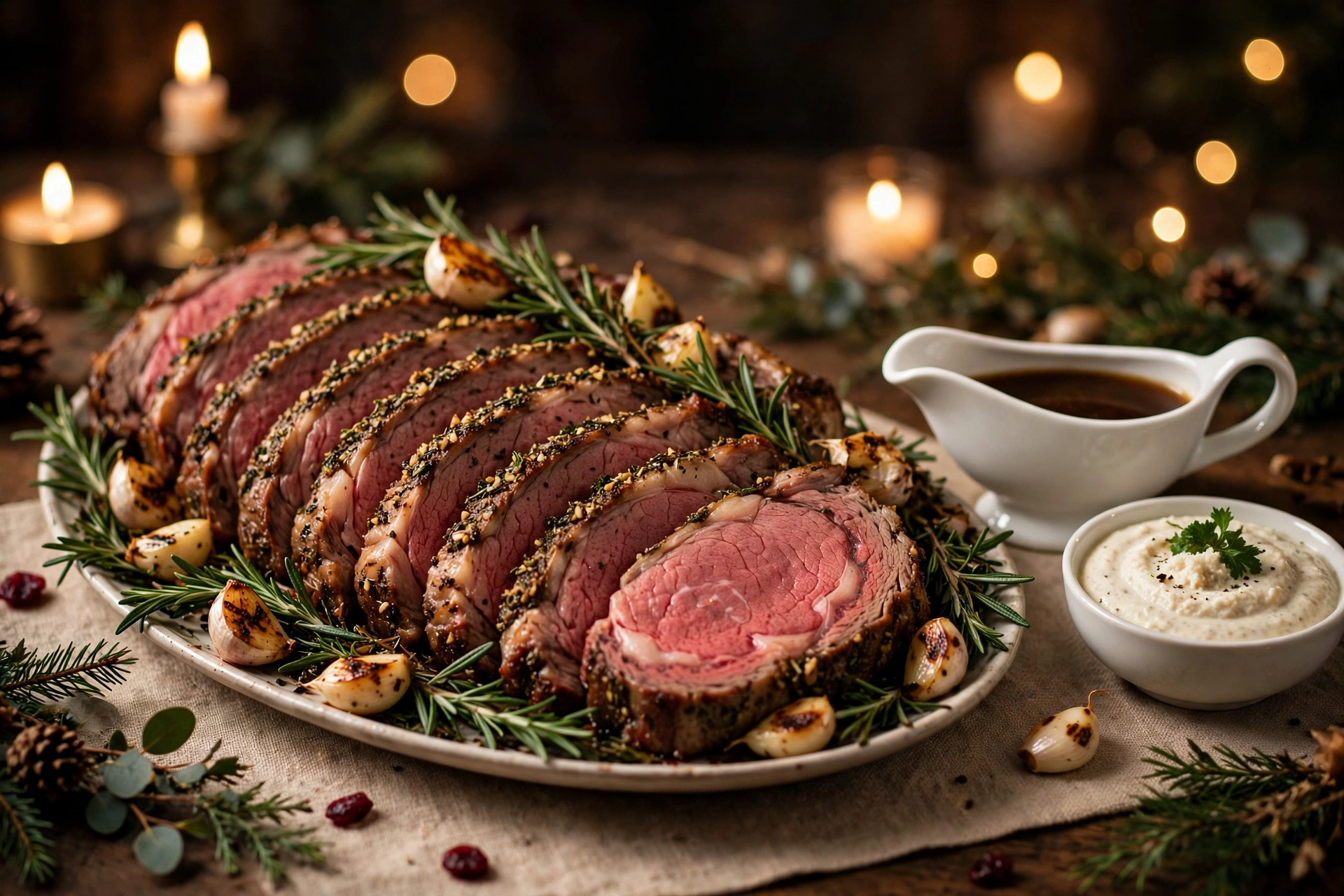
- Carve with confidence. Slide a long carving knife along the bones to release the rack, then slice the eye into 1/2-inch thick slices against the grain. Arrange on a warm platter, spoon over a little of the pan juices, and serve with the horseradish sauce alongside.
Why This Method Works (The Technique, Explained)
Most prime rib disasters come from heat that is too aggressive. A blazing-hot oven browns the outside fast but overshoots the inside, leaving you with a gray, dry ring around a too-rare center. Roasting low at 275°F flips that script: gentle heat creeps through the meat evenly, so the center reaches temperature without the outer layers overcooking. The result is that coveted edge-to-edge rosy pink you see in steakhouse photos.
The pull temperature is the whole game. Meat keeps cooking after it leaves the oven — residual heat drives the internal temperature up several degrees during the rest. By pulling at 140°F and resting 20 minutes, the roast lands right at 145°F, the USDA recommended minimum for whole beef cuts like roasts and steaks, served with a 3-minute rest. That is why the recipe works every time: you are not aiming at a moving target, you are aiming below it on purpose and letting physics finish the job.
The garlic-herb paste does double duty. The olive oil and butter baste the surface as they melt, carrying fat-soluble flavors from the rosemary and thyme deep into the outer crust, while the minced garlic toasts into a savory, nutty armor. And because you slather rather than stud, there are no garlic chunks to burn bitter. Roasting the meat bone-side down means the rib bones act as a natural rack, lifting the roast so hot air circulates underneath and the bottom never steams.
One more quiet hero: tempering. A 5-pound roast straight from the fridge can take an extra 45 minutes to cook through, and the outside always suffers. Two hours on the counter evens the starting temperature, keeps the cooking time predictable, and stays safely within the 2-hour room-temperature limit for perishable foods. (Fun fact for the dinner table: a standing rib roast, better known as prime rib, is simply a cut from the primal rib section roasted standing on its bones, which is exactly what gives the dish its name.)
Pro Tips for a Perfect Prime Rib
- Buy by the bone, not by the pound. One bone feeds about two people generously. A 3-rib, 5-pound roast serves 8; for a bigger crowd, go to 4 ribs (about 7 pounds) and add roughly 20 minutes per extra pound at 275°F.
- Salt early if you can. Salting the roast the night before and resting it uncovered in the fridge gives you a drier surface (better browning) and deeper seasoning. Just add the herb paste on roasting day.
- Trust the thermometer, not the clock. Ovens lie and roasts vary. A reliable instant-read thermometer is the single most important tool here — check in the thickest part of the eye, away from bone.
- Want an even deeper crust? After the roast hits 140°F, blast it at 500°F for 8 to 10 minutes before resting. The outside crisps like a dream while the center barely budges.
- Warm the platter. Slide your serving platter into the oven during the last 10 minutes of resting time (oven off). Warm porcelain keeps the slices juicy and hot at the table.
- Save every drop of juice. The drippings in the roasting pan are liquid gold. Skim the fat, warm them gently, and spoon over the sliced meat or turn them into a quick au jus.
Common Mistakes and How to Fix Them
- Mistake: Skipping the thermometer. Cutting into the roast to “check” lets juices escape and guesses at doneness. Fix: a $15 instant-read thermometer ends this problem forever.
- Mistake: Roasting at 350°F or higher. Hot and fast gives you a thick gray band and a small pink center. Fix: stay at 275°F and let time do the tenderizing.
- Mistake: Skipping the rest. Slicing right away floods the cutting board with the juices that belonged in your meat. Fix: tent loosely and wait the full 20 minutes. Seriously. Pour the wine while you wait.
- Mistake: Undersalting. A roast this thick shrugs off timid seasoning. Fix: the full 2 tablespoons of kosher salt, rubbed everywhere. The crust should taste seasoned on its own.
- Mistake: Carving with the grain or too thick. Tough slices ruin even a perfectly cooked roast. Fix: remove the bone rack first, then slice 1/2-inch thick across the grain — the knife should glide with zero resistance.
Substitutions and Variations
- Boneless rib roast: works beautifully with the same method. Use kitchen twine to tie it into an even cylinder so it cooks uniformly, and start checking the temperature about 30 minutes earlier.
- Herb swaps: rosemary and thyme are the classic Christmas duo, but oregano, marjoram or a spoonful of herbes de Provence all play nicely in the paste.
- No Dijon? Whole-grain mustard gives a rustic texture; yellow mustard works in a pinch but use one tablespoon less.
- Dairy-free crust: skip the butter and use an extra 1/4 cup of olive oil. The crust still browns gloriously.
- Smaller gathering? A 2-rib roast (about 3.5 pounds) follows the exact same steps; start checking at 2 hours 15 minutes.
- Serving a crowd? Pair this centerpiece with garlic butter dinner rolls for mopping up juices, cheesy scalloped potatoes for creamy comfort, and easy 5-ingredient corn casserole for a sweet, golden side that loves roast beef.
Storage and Make-Ahead
- Make-ahead: Salt the roast up to 24 hours ahead and refrigerate uncovered. Make the herb paste and horseradish sauce a day ahead too; refrigerate both separately. Let the roast temper 2 hours before it goes in the oven.
- Refrigerate leftovers: cool sliced or unsliced roast within 2 hours of serving, then refrigerate in airtight containers for 3 to 4 days.
- Freeze: wrap tightly in plastic wrap, then foil or a freezer bag, and freeze up to 3 months. Thaw overnight in the refrigerator.
- Reheat gently: warm slices in a 275°F oven, tented with foil and splashed with a little beef broth, until just warmed through (about 15 minutes). Never microwave — it turns pink centers gray in seconds.
- Leftover ideas: thin-slice cold prime rib for the most luxurious sandwiches of your life, chop it into beef barley soup, or crisp cubes in a hot skillet for steak-and-egg breakfast hash.
A note on nutrition: beef is a solid source of complete protein, vitamin B12, iron and zinc — nutrients that support everyday energy and a balanced diet — while also being rich, so this is a celebration dish to enjoy in moderation as part of varied holiday eating. Details on beef’s nutrition profile are summarized well on Healthline’s beef nutrition guide.
Frequently Asked Questions
What temperature should prime rib be cooked to?
Pull the roast from the oven when an instant-read thermometer reads 140°F in the thickest part of the eye. After a 20-minute rest under loose foil, carryover cooking brings it to 145°F, which is the USDA recommended minimum internal temperature for whole beef cuts, held with a 3-minute rest. The result is a juicy, warm pink medium center every time.
How long does it take to roast a 5-pound prime rib?
At 275°F, a 5-pound bone-in prime rib takes about 3 hours to reach 140°F internally. Add 2 hours of room-temperature tempering beforehand and a 20-minute rest afterward, for a total of about 5 hours 40 minutes from counter to table. Always cook to temperature, not to time — start checking about 15 minutes early.
Should I sear prime rib before roasting?
You do not need to sear first with this low-and-slow method. The long, gentle roast at 275°F develops a deeply browned, flavorful crust on its own thanks to the garlic-herb butter paste. If you want extra crunch, add an optional 8 to 10 minute blast at 500°F after the roast reaches 140°F, right before resting.
How do I store and reheat leftover prime rib?
Refrigerate leftovers within 2 hours of serving and use within 3 to 4 days, or freeze tightly wrapped for up to 3 months. Reheat slices gently in a 275°F oven, tented with foil and a splash of beef broth, for about 15 minutes. Avoid the microwave, which overcooks the pink center in seconds.
Rate this recipe
Be the first to rate it!